
Back in 1959, Rolls-Royce unveiled its flagship limousine, the Phantom V, to succeed the venerable Silver Wraith. This was no mere sedan — it was a grand, chauffeur-driven beast of a car, built for royalty, heads of state, and the world’s elite. With only about 516 Phantom Vs ever produced, each was essentially a canvas for bespoke elegance and engineering.
By default, these grand limousines were draped in sober black, meant for formal events or discreet private service. Their stately presence demanded dignity, discretion, and perhaps a chauffeur’s hand on the door. In the early 1960s, one particularly dramatic incident underscored the Phantom V’s legendary build quality: in 1965, a Phantom V carrying the Duke and Duchess of York rolled down an embankment, flipped multiple times, and ended up upside-down. Miraculously, none of the passengers was seriously hurt — the car was rebuilt, returned to service, and continued to serve the royal household.
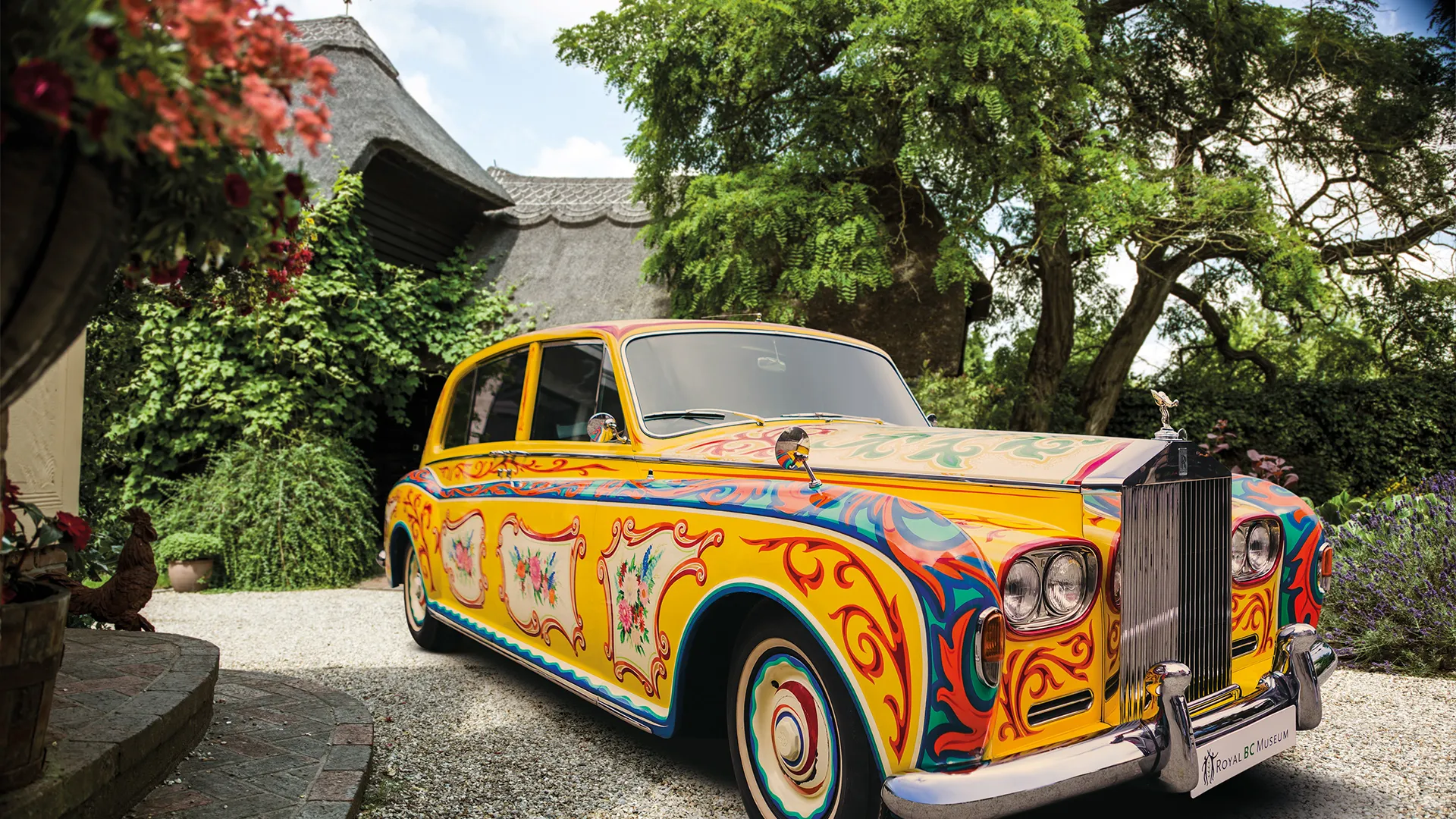
Initially plain black, Lennon had the carbrepainted in bright gypsy caravan–style florals, shocking Britain’s high society.
Enter Lennon’s Phantom — From Monochrome to Mayhem
Fast-forward to December 1964, and The Beatles are in full swing, dominating popular culture with hits like A Hard Day’s Night. John Lennon, always one to push boundaries, commissioned his own Phantom V through the Rolls-Royce dealer R. S. Mead in Maidenhead. But this was no standard limo. Lennon wanted black everywhere — body, trim, interiors — as if to swallow up light and expectations. The only nod to tradition that survived was the iconic grille and the Spirit of Ecstasy hood ornament, which Rolls-Royce insisted must remain in chrome.
When it was delivered in June 1965, the car was a stealth statement on wheels: gloss black paint, black bumpers, black wheel discs, and even the trim was painted black. To add more mystique, Lennon equipped it with darkened Triplex Deeplight glass, making the windows reflective and nearly opaque by design. Lennon famously explained that beyond privacy, the blacked-out interior meant that even on bright sunny days, the interior would remain dark — “you’re still in the club,” he told one interviewer.
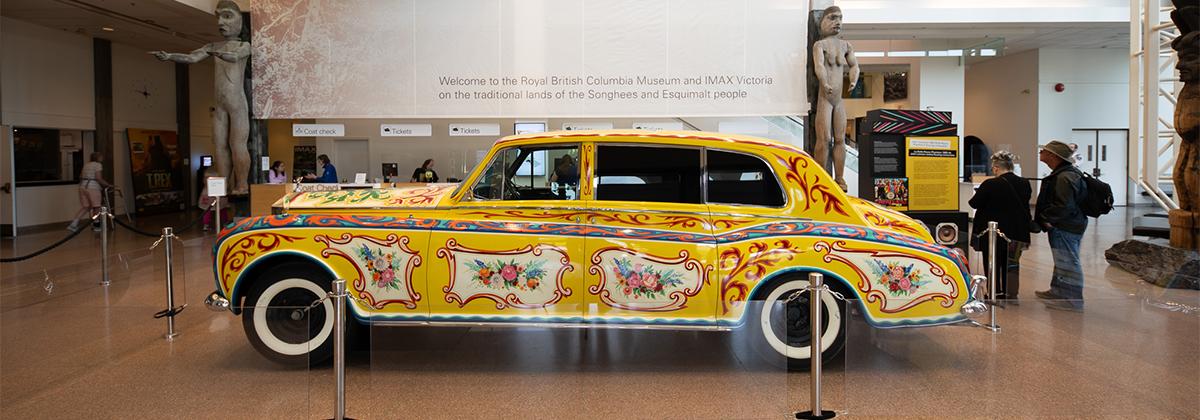
John Lennon’s psychedelic Rolls-Royce Phantom V is now at the Royal British Columbia Museum in Victoria, Canada.
Inside, the décor stuck to the all-black theme: the rear compartment sported black Bedford cord cloth, contrasted with black nylon rugs, while the front got black leather. The car came with traditional Rolls-Royce luxuries: a cocktail cabinet, reading lamps, a writing table, and a seven-piece black luggage set. Also tucked into the trunk was a refrigerator — not typical, but fitting for a rock star’s limo. Some reports have the addition of a record player, radio telephone, and hidden speakers, though whether all were there at delivery or retrofitted later is a bit of legend.
Metamorphosis: Psychedelic Yellow & Flower Power
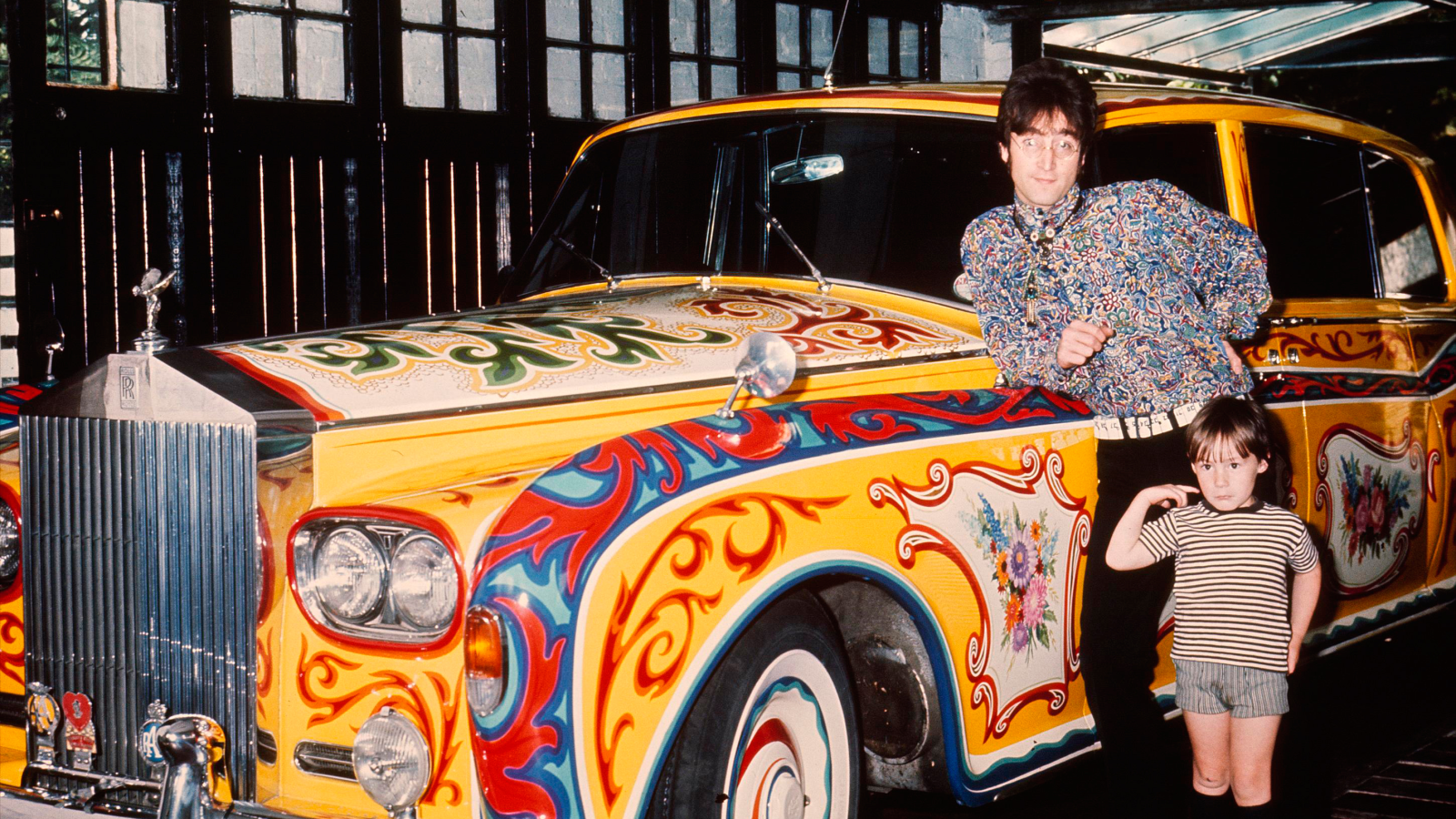
By 1966, the car had seen action — including during Lennon’s filming in Spain for How I Won the War, where the black matte finish was scuffed and battered. Rather than restore it to black, Lennon made a bolder move: he turned it upside-down figuratively and visually by enlisting the coachbuilders J.P. Fallon Ltd. to repaint the Phantom in blazing yellow and transform its body into a swirling tapestry of color, florals, Romany scrolls, and zodiac motifs. The work was done by artist Steve Weaver, who painted red, orange, green, and blue curves and floral panels. On the roof, the Libra symbol, Lennon’s zodiac sign, made its bold presence known.
The repaint was timed just ahead of the release of Sgt. Pepper’s Lonely Hearts Club Band. When the newly psychedelic limousine hit the streets, it exploded into press coverage and public shock. Lennon had achieved exactly what he set out to do: something extravagant, unique, and disruptive.
Of course, not everyone was delighted. Legend has it that a London woman, incensed at what he had done to a Rolls-Royce, marched outside and struck the car with her umbrella. Lennon loved to recount that story.
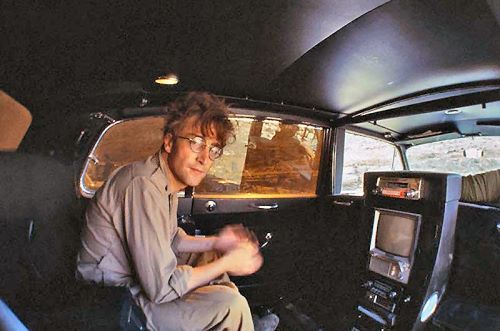
Lennon had the Phantom fitted with a backseat that converted into a double bed, a TV, telephone, refrigerator, and even a record player with loudspeakers.
High Drama Behind the Scenes
During its service, Lennon’s Phantom V wasn’t just a rolling gallery; it was also a mobile command center. Later customizations included a rear seat that folded out into a double bed, a trunk-lodged radio telephone, record and tape player systems, and hidden speakers powerful enough to shake the street.
By 1965, Lennon had the car pulled in for upgrades — estimates in modern dollars suggest he poured roughly $50,000 into bespoke work on the vehicle. He wanted it to reflect his evolving persona — not just a rock star’s ride, but a statement.
After its vivid transformation, the car served Lennon until 1969. In 1970, when he and Yoko Ono moved to the U.S., the Phantom crossed the Atlantic. In 1977, the couple donated it to the Cooper-Hewitt Museum as a tax deduction. The museum later sold it at auction in 1985 for a staggering $2.3 million, which at the time was one of the highest prices ever paid for a car. The new owner donated it to the Royal British Columbia Museum, where it remains on display, occasionally touring as one of pop culture’s most iconic art cars.
Legacy & Reverence
Today, Lennon’s Phantom V is more than just a car — it’s a piece of 1960s rebellion, iconoclasm, and imagination on wheels. It has been shown worldwide, a centerpiece in exhibitions like The Great Eight Phantoms, and remains a magnet for fans of music, art, and automotive history. The museum conservators care for it with extreme precision, since the yellow base coat was done in latex house paint, fragile for a car. Doors, hoods, and vibrations potentially chip the finish, so each movement is treated as a delicate dance.
In a way, the very spirit of Rolls-Royce — a brand synonymous with bespoke craftsmanship, bold commissions, and pushing the boundaries of possibility — found an unexpected champion in Lennon’s wild ride.