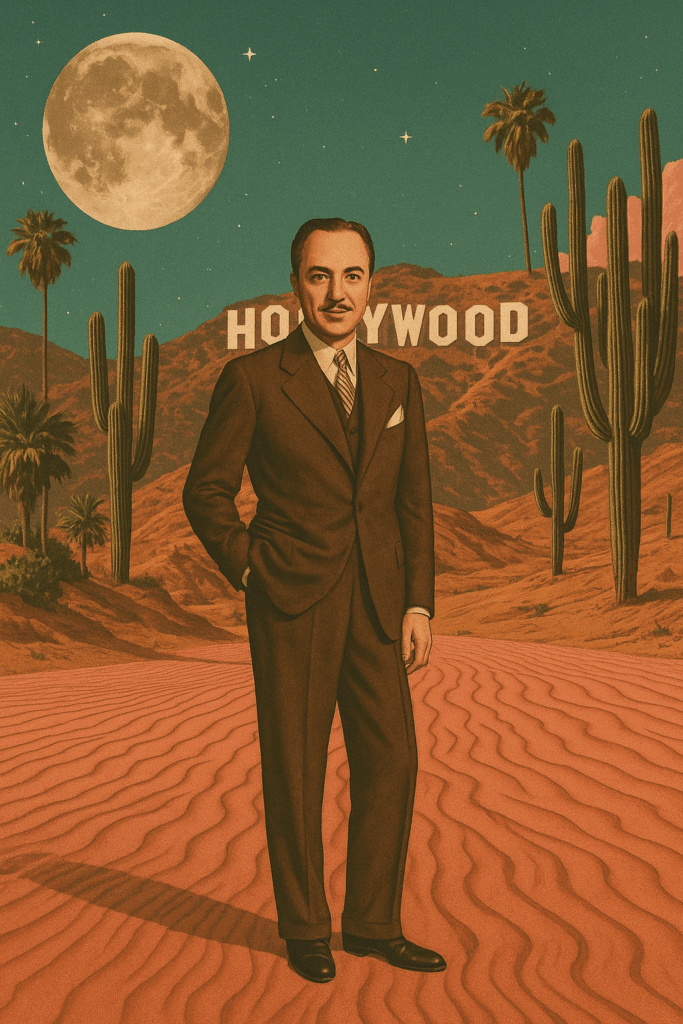
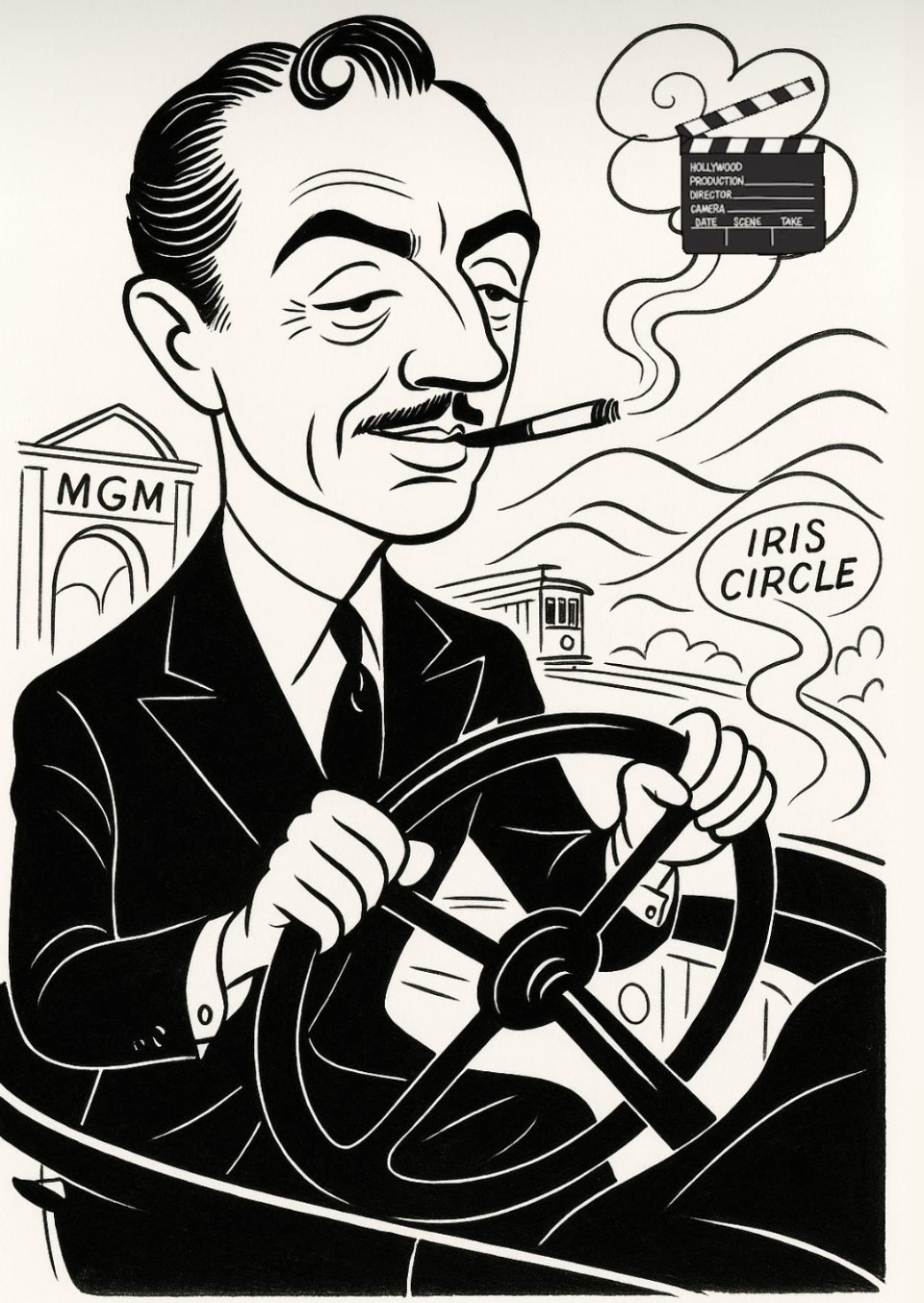
Los Angeles, 1932. The studio gates of MGM open like the mouth of an enormous iron beast, releasing a flood of tired actors, grips, electricians, and secretaries. Among them is William Powell— immaculately pressed, and newly wed to Carole Lombard. The man the public knows for his polished detectives and witty leading men steps into his Packard Twelve and points it north, toward the winding roads of Whitley Heights.
This was not a long drive—just eleven miles from Culver City to the Hollywood Hills—but in the geography of early studio-era Los Angeles it was a world away. Culver City was the factory floor of dreams, with its backlots and sheds and dressing-room caravans. Whitley Heights was its cloister: the place where stars retreated, closed their gates, and attempted to live like ordinary men and women while their faces glowed ten feet tall downtown. Between the two lay Santa Monica Boulevard, a sun-struck artery that carried everyone from farmers to starlets, crowded with streetcars and the smell of gasoline.
For two years, from 1931 to 1933, and still driving himself, Powell made this commute almost daily.
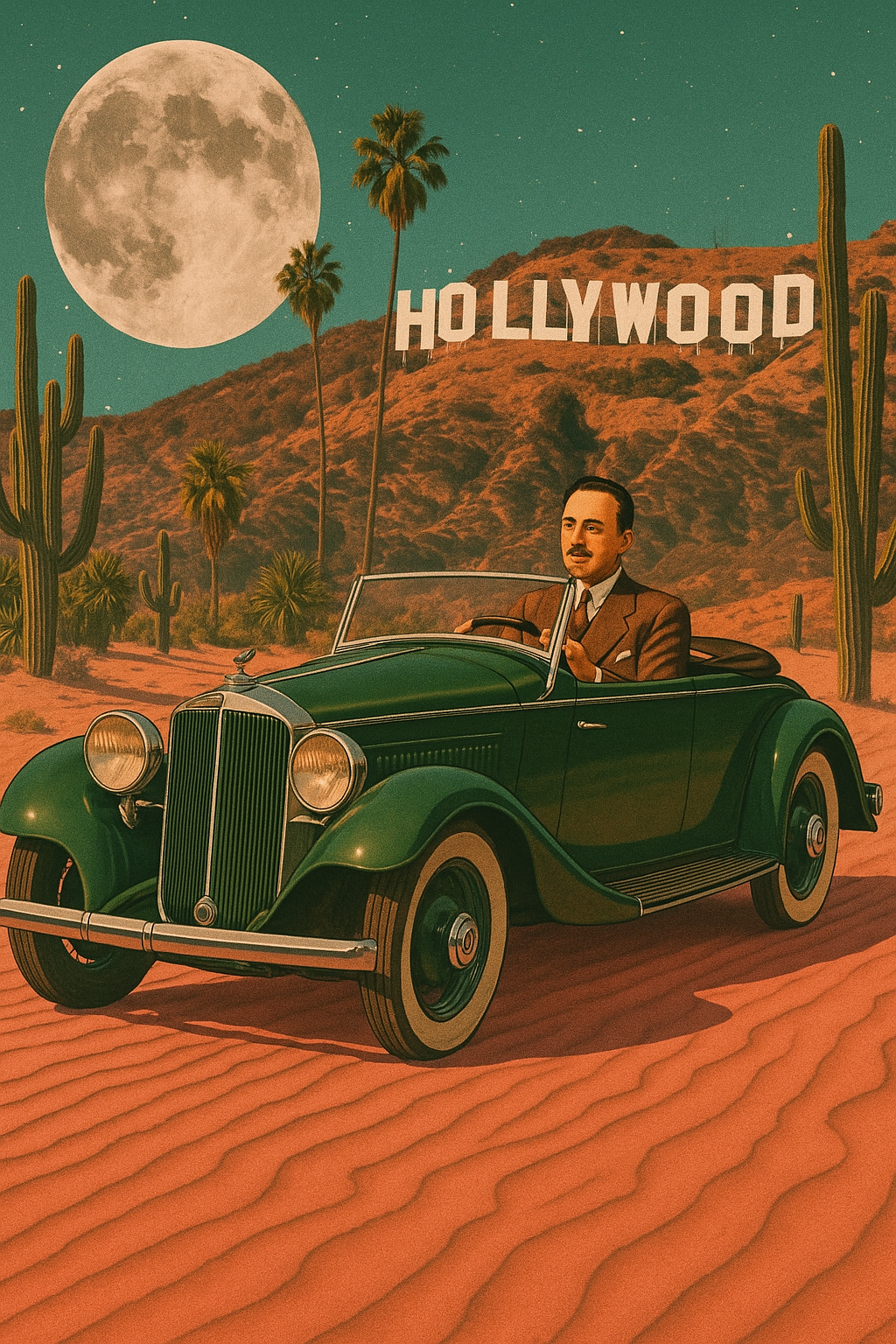
The marriage to Lombard, brilliant but brief, would collapse after scarcely twenty-four months. The house on Iris Circle would be sold. But for a little while, William Powell’s life traced this line through the city: Washington Boulevard to Robertson, Santa Monica east to Highland, then up the narrow climb to his Spanish villa perched above Hollywood.
The Villa on Iris Circle
The house at 6861 Iris Circle was a romantic choice. Built in the Spanish Colonial Revival style that Los Angeles architects favored in the 1920s, perched high enough to catch breezes but close enough to Hollywood Boulevard that Powell could hear the faint echo of traffic below. Stucco walls, terracotta roof tiles, and arched doorways gave the house an Old World dignity, while its terraces looked out across the still-growing city.
Whitley Heights was Hollywood’s first true celebrity enclave.
Rudolph Valentino had courted Natacha Rambova there. Buster Keaton threw parties there. Gloria Swanson kept an address on its twisted lanes. The neighborhood’s appeal was obvious: it was just minutes from Hollywood Boulevard, but the narrow, labyrinthine roads deterred tourists and reporters. For stars like Powell and Lombard, privacy mattered almost as much as the mortgage.
Leaving MGM
Each evening, Powell emerged from MGM’s gates in Culver City. The lot was at once grand and utilitarian. Inside were Art Deco office buildings and cavernous soundstages; outside, Washington Boulevard was just another industrial strip lined with filling stations and lunch counters.
Picture Powell sliding into a dark sedan—he favored understated cars such as the aforementioned Packard, unlike some contemporaries who posed with gleaming Duesenbergs. He may have had a chauffeur at times, but colleagues remembered him as a man who enjoyed independence. So it’s easy to imagine him behind the wheel himself: the engine coughing to life, the fourth-to-last cigarette of the day lit as he steered east into the crush of traffic.
The smell was equal parts oil and citrus. Los Angeles in those years was still ringed with groves, and the evening air carried a faint sweetness that mingled with exhaust. The sky itself was a wash of color, smog not yet thick enough to obscure the view: orange haze over the Palos Verdes hills, indigo deepening toward the San Gabriels.
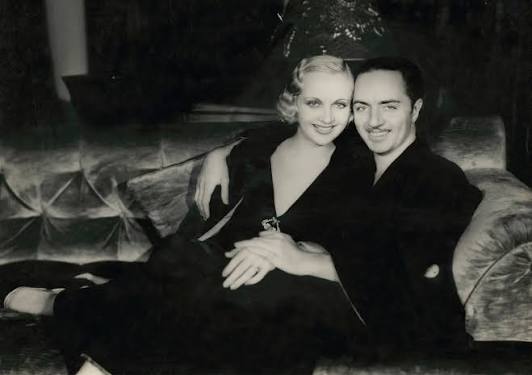
Safe at home with wife Carole
Washington to Santa Monica
The first leg took him east along Washington Boulevard. The pavement was rough; trucks from the harbor rattled by, hauling goods to and from downtown. At Robertson or La Cienega he turned north, past billboards promising Chesterfields and Lux Toilet Soap.
Santa Monica Boulevard was the true corridor of his commute. It was part of U.S. Route 66, America’s “Main Street.” Streetcars clanged along its center tracks, slowing the flow of Packards and Buicks. West Hollywood in the early 1930s was neither fully glamorous nor fully tamed: gas stations, roadside markets, speakeasies that flickered to life after dark. Powell, trim in his suit, would have looked both ordinary and unmistakable as he threaded through it.
This was the stretch where a man could think. The boulevard unrolled like a film reel: the city flickering past, the day’s lines still echoing in his head. Powell was not a method actor, but he prepared thoroughly, and his characters—Philo Vance in The Kennel Murder Case (1933), the gentleman thief in Jewel Robbery (1932)—clung to him after the cameras stopped. Perhaps he rehearsed a retort in the car, half-speaking it to himself. Perhaps he drove in silence, eager for the quiet of the hills.
North on Highland
At Highland Avenue the mood shifted. Here the traffic thickened. Hollywood Boulevard was ablaze with neon by night: theaters, restaurants, the odd chorus girl darting across the street. By day it was noisy, crowded, restless.
Powell turned north and began the climb. His Packard’s headlights cut arcs across stucco walls and tall palms. Then the road narrowed: Milner Road twisting, Iris Circle curling back on itself like a ribbon. Suddenly the city noise receded. In its place: crickets, the faint sound of a radio drifting from a neighbor’s terrace, and the sight of Lombard waiting at the doorway.
Life at Iris Circle
For Carole Lombard, barely 23 when she married 38-year-old Powell, this house was both a honeymoon nest and a crucible. She was on the cusp of stardom but not yet secure. Powell was urbane, witty, and already one of MGM’s most reliable leading men. They seemed, at first, a perfect match: she, irreverent and lively; he, polished and debonair.
But the house witnessed quarrels as well as dinners. Powell preferred a quieter life; Lombard craved noise and risk. By 1933, they divorced, citing irreconcilable differences. Friends whispered that the gap in age and temperament had been too wide. Lombard moved on to the heady screwball roles that would define her, while Powell remained in Whitley Heights until he too moved westward, to a grander house in Beverly Hills.
Films of the Commute Years
The films Powell made during his Iris Circle years captured his evolution:
• Man of the World (1931)
• Ladies’ Man (1931)
• Jewel Robbery (1932)
• Lawyer Man (1932)
• The Kennel Murder Case (1933)
These roles honed the persona that would explode with The Thin Man in 1934: witty, intelligent, never ruffled, and always perfectly dressed.
The Commute as Symbol
Driving home from MGM each night, Powell traversed more than miles. He passed through layers of Los Angeles: industrial Culver City, restless West Hollywood, neon-lit Hollywood Boulevard, then the cloistered hills. The commute mirrored his life: professional success rising, personal life faltering, the surface elegance barely hiding the fractures underneath.
And yet, to imagine him steering that Packard up Iris Circle is to glimpse a man who found solace in routine. The road bent upward, the noise dropped away, and Hollywood at last receded into quiet.
From Hillside Villa to Canyon Estate
When Powell and Lombard divorced in 1933, Powell’s career surged. He soon starred in The Thin Man (1934), earning an Oscar nomination, and later in My Man Godfrey (1936) at Universal. With success came a larger home.
Powell moved from Whitley Heights to 1220 Benedict Canyon Drive, Beverly Hills—a sprawling estate of more than 7,000 square feet, complete with gardens and a pool. By comparison, Iris Circle had been about 3,400 square feet. The new address announced his permanence: he was no longer just another contract actor; he was a fixture of Hollywood.
The route between the two houses was short: down Highland, west along Santa Monica Boulevard, then into the leafy canyons. Where Iris Circle perched above Hollywood’s bustle, Benedict Canyon embraced him in seclusion.
At the Beverly Hills estate, Powell hosted friends, including Jean Harlow, his great love until her tragic death in 1937. The house became a refuge as well as a stage for his stardom.
During these years he made:
• The Thin Man (1934)
• Evelyn Prentice (1934)
• Rendezvous (1935)
• My Man Godfrey (1936)
• Libelled Lady (1936)
Powell’s career was at its zenith, his image inseparable from the urbane man audiences adored.
William Powell’s commute may seem like a small detail in a long career, but it captures something essential about Hollywood in the 1930s. The city was not yet defined by freeways; its stars navigated the same crowded boulevards as everyone else. The glamour of Whitley Heights or Beverly Hills began only after the long wait behind a streetcar or the slow climb up Highland Avenue.
For Powell, those drives were the thread between two lives: the public man of MGM, sharp as a cocktail glass, and the private husband, uncertain and searching. When he moved from Iris Circle to Benedict Canyon, he left behind not just a marriage but a version of himself. The roads of Los Angeles carried him onward, as they always did, through smog, neon, and the ceaseless reinvention of a city and an actor who never quite let the mask slip.