
Sleeping Where Joan Crawford Started with Mommy Dearest at the Desk
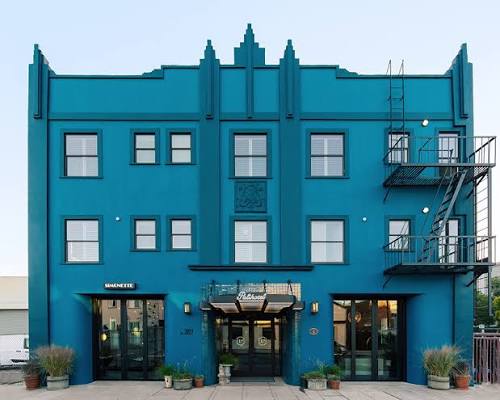
We booked the Palihotel Culver City for practical reasons. Culver City had a good reputation, and its location made sense for a Los Angeles weekend: near enough to the beach, with plenty to explore in the neighborhood. Then I saw the building. The Deco lettering, the street numbers, the old façade—something about it made me want to know who had walked through that door before us.
But first, we had to check in.
I walked up to the desk expecting the ordinary pleasantries that begin a hotel stay. Instead, I got a scowl. The young curly haired woman behind the counter seemed distinctly unimpressed by our arrival, and standing there, I felt that I had somehow inconvenienced her by booking a room. The building had drawn me in. The welcome made me wonder whether I should have stayed outside.
This was our second visit in a year, and the latest front-desk encounter was the worse of the two. I had liked the hotel enough to return. Apparently, the enthusiasm was mine alone. None of the staff seems particularly happy to work here or extend warmth to its guests.
The history, however, turned out to be worth coming back for. Long before it became a boutique hotel with moody colors and botanical wallpaper, this was the Washington Hotel, where a young woman named Lucille LeSueur arrived with an MGM contract and a future she could barely have imagined.
You know her as Joan Crawford.
Before She Was Joan
On January 3, 1925, Crawford arrived in Los Angeles after receiving a Christmas telegram offering her a studio contract worth $75 a week. She was taken to the Washington Hotel on Van Buren Place, which became her home for more than six months.
The building dated to 1923. MGM was a short walk away, placing an aspiring actress close to the machinery that could turn her into a star.
What stayed with me was Crawford’s recollection of those first months. She remembered being happy there, reluctant to go to sleep and eager to wake because each day held promise. Only later did she notice that the hotel was, in her words, “sort of a dump.”
The place had stayed the same. Her expectations had grown.
That is a much more interesting hotel story than a celebrity spending one night in a penthouse. Crawford lived here while her career was taking shape. Before the famous name meant anything, she needed somewhere to sleep and a way to get to work.
The Washington eventually became the West End Hotel. After restoration, it opened as Palihotel Culver City in 2019.
Walking through it now, I found myself trying to see past the decorating. Somewhere beneath the boutique finish was the modest hotel that had given Crawford her first Los Angeles address.
A Beautiful Place to Be Snubbed
The present-day hotel gives you plenty to look at. Its 49 rooms are compact and deliberately styled, with rich colors, vintage touches and the sort of botanical pattern that makes you stop to examine the wallpaper. Our room was petite, but the decorating gave it personality. If you like generous floor space, pay attention to the room dimensions before booking.
The leafy courtyard was another pleasure. So was being able to step outside and explore downtown Culver City rather than begin every outing by retrieving the car.
I could see why we had returned. I could also see how much the service undermined the setting.
At the desk, the attitude felt like a challenge: prove that you deserve my attention. At the valet stand, I came away with a similar impression—that the exchange revolved around what we could do for him. We’ve always had great customer service in the LA area at hotels and restaurants so the coldness here came as a shock.
One older manager offered a welcome exception. She spoke with my husband as he headed to his car, and her warmth stood out immediately. A friendly conversation should hardly be the memorable service event of a hotel visit, yet here it was.
She also demonstrated how easily the mood could change. The hotel already had the atmosphere, the location and the history. She supplied the hospitality.
What a Welcome Should Feel Like
The Ritz-Carlton offers a useful yardstick because its service philosophy explains what a hotel owes the person walking through its doors. Its famous motto—“Ladies and Gentlemen serving Ladies and Gentlemen”—gives dignity to both sides of the counter.
Reading its Gold Standards, I was struck by how much of the philosophy concerns ordinary human consideration. The highlights:
- Make guests comfortable. Their care and comfort are the central purpose of the stay.
- Begin warmly. The Three Steps of Service start with a sincere greeting and recognition by name.
- Pay attention. Anticipate needs and respond to what guests express, as well as what they may leave unsaid.
- Take responsibility. Employees are expected to own guest problems and resolve them promptly.
- End graciously. A warm farewell matters as much as the first hello.
My reading of that ethos is simple: everyone should be able to relax. Guests are welcome to be there.
At the Palihotel, I felt self-conscious about asking for the attention that checking in requires. That is an awkward way to begin a vacation.
For our experience, I would give the service one out of five, with the manager earning that point.
Five Reasons to Step Outside
Fortunately, Culver City gives you plenty of reasons to leave the lobby.
Sony Pictures Studios. Start with the former MGM lot, where Crawford’s career began. The guided walking tour takes visitors onto a working studio lot with soundstages associated with films including The Wizard of Oz. Reserve ahead.
The Culver Hotel. This distinctive 1924 landmark offers another chapter of the neighborhood’s Hollywood history. Its wedge-shaped building is worth a look even before you explore its stories.
The Museum of Jurassic Technology. On Venice Boulevard, this unusual museum makes a good change of pace after the studio landmarks. Allow time to linger, and check admission arrangements before going.
The Wende Museum. At 10808 Culver Boulevard, the Wende offers art, history and a different lens on the past. Check its exhibition calendar and public visiting hours.
The Helms Bakery District. Save some time for browsing the shops and design showrooms. Part of the pleasure of staying in Culver City is discovering how much there is beyond its movie history.
Back at the Palihotel, I still liked looking at the building. I still liked knowing that Crawford had lived there before anyone knew what she would become.
She remembered waking up eager for the day ahead. I would have settled for someone at the desk seeming pleased that ours had brought us there.
But let’s hear from Joan herself about those early days in Culver City, when she had a room at the Washington Hotel and six months to convince MGM to keep her.
“I had six months to prove something,” she wrote in A Portrait of Joan.
Her arrival had hardly inspired confidence. At the Los Angeles train station, she searched for the welcoming party she assumed MGM would send. As the crowd disappeared, she ended up crying against a pillar. The studio had dispatched a young publicity employee, but he had been looking for someone considerably more imposing than the girl in front of him.
After dropping her suitcase at the Washington, she went to sign her contract. Her screen test followed the next day. Asked to cry, she thought about that six-month deadline and found she couldn’t stop. An electrician who had once danced in vaudeville helped break the tension by challenging her to a dance step.
Once on the lot, she watched established stars whenever she could, especially during night shoots.
“I used to steal onto the back lot and stand in the shadows, watching.”
That was the Joan who lived here: frightened, curious and determined to learn. The Washington looked better through the eyes of someone who had just been given a chance. Months later, she noticed its shabby surroundings and delivered a wonderfully dry verdict:
“It hadn’t changed, so I guess I had.”