
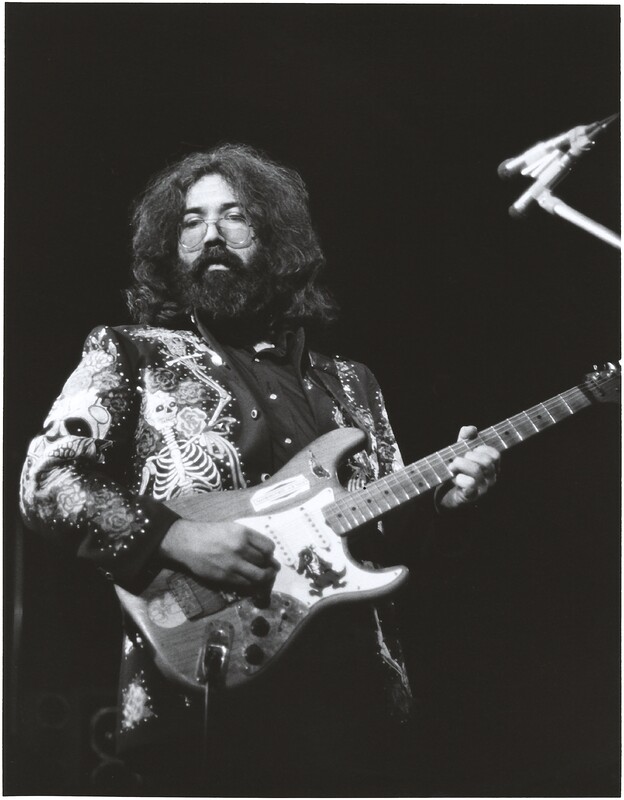
Anyone who knows the Grateful Dead knows Jerry Garcia did not play dress-up.
He was known for wearing identical black pocket T-shirts – often simple Fruit of the Loom crewnecks – a minimalist look meant to deflect attention onto the music.
And in photographs from the mid-’70s on he favors a look best described as competent disregard – flannel, sweatpants, the odd tie-dye someone handed him backstage and glasses. And the beard, of course. He was, by every account, sloppy on purpose and completely unbothered by it.
Which is what makes the wardrobe choices in the fall of 1972 such an odd little detour.
For a handful of shows, spanning one Texas run and a Winterland New Year’s, Jerry Garcia walked onstage in a black gabardine suit covered in rhinestones, with a skull embroidered on the leg surrounded by flowers and ribbons, made by the same Hollywood tailor who dressed Elvis Presley in gold lamé.
A Tailor Named Nudie
The suit came from Nudie’s Rodeo Tailors, a shop on Lankershim Boulevard in North Hollywood run by a man born Nuta Kotlyarenko in Kiev in 1902. His family fled the pogroms when he was a child; he landed in New York, apprenticed as a tailor, boxed for a while, and eventually made his way to California, where a customs clerk’s mangling of his name gave him the one he kept. By the time the Grateful Dead found him, Nudie Cohn had already dressed half of American music’s royalty: Hank Williams in white with musical notes stitched across the chest, Porter Wagoner in a covered wagon, Elvis in a suit that reportedly cost ten thousand dollars in 1950s money.
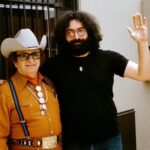
Jerry with Nudie
Gram Parsons had gone to Nudie’s with the Flying Burrito Brothers in 1968 and come away later with a jacket embroidered in marijuana leaves, pills, and pinup girls, flames climbing his pant legs toward an embroidered cross on the back – sin and salvation, stitched by hand. Nudie himself drove customized convertibles studded with silver dollars and topped with steer horns, and he wore his own designs everywhere he went, because as far as he was concerned, real men wore rhinestones. By 1972 the Nudie suit had become a kind of country-music merit badge, the outfit you got made once you’d decided you belonged in that world. Which is the part that makes Garcia’s suit strange: nobody in the Grateful Dead believed they belonged in that world.
Whose Idea Was This?
The most reliable account comes from Steve Parish, who worked as the band’s guitar tech and later ran their whole road operation for decades.
“We were in Los Angeles in 1973,” he told Sotheby’s, years later. “We decided to go to Nudie’s Rodeo Tailors on a lark. They were famous for dressing all the country artists and we were headed to Texas soon.” Parish’s date lands a year later than the earliest surviving photographs, which show Garcia in the suit at a show in Houston in November 1972 and again at Winterland that December — one more small discrepancy in a band whose own history rarely agrees with itself.
Garcia was first. And buying a Nudie suit wasn’t an impulse purchase – you had to go in for a fitting, choose your own embroidery, and pay a hefty sum for the privilege.
It’s the least Garcia-like transaction imaginable.
Bob Weir, interviewed with his sister Frankie for Crawdaddy in August 1972, said: “I could go down and get a Nudie suit and they still wouldn’t believe it. Garcia has one.” Frankie noted in the same interview that Jerry didn’t have the nerve to wear it and that he’d hauled it across an entire European tour without once putting it on. But at the same time, she added, if the suit didn’t make it onto the bus he’d tear the room apart looking for it.
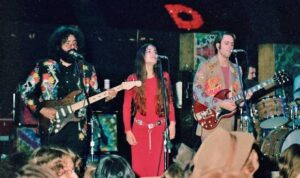
Donna didn’t get one
Weir got his own not long after. So, eventually, did Phil Lesh, and by most accounts keyboardist Keith Godchaux had at least a Nudie jacket if not the full ensemble. There’s also photos of drummer Bill Kreutzmann wearing one.
What They Actually Wore
Garcia’s suit, the one that survives in photographs and eventually in an auction catalog, was black gabardine with a skull worked into the side of each pant leg, wreathed in flowers and ribbon, rhinestones running along the belt loops, his name – Jerry Garcia – sewn onto a tag at the pocket. Lesh went a different direction, lower-key by design, embroidery instead of rhinestone shout. One fan who saw the band that winter remembers a jacket back that read, in huge black letters, simply “The Grateful Dead.”
They wore the Nudie suits sparingly, and only for a short window.
A show in Houston in November 1972, on a bill that put them alongside Texas roadhouse legend Doug Sahm.
Winterland in San Francisco on December 12.
New Year’s Eve, sliding into 1973.
A handful of dates on the East Coast that February, including a night at the Philadelphia Spectrum where, by one attendee’s memory, Garcia and Weir made a whole bit of it before the first song — showing the suits off to the crowd like a fashion show, rhinestones catching the stage lights, the two of them clearly enjoying how ridiculous they looked.
So if you are a Grateful Dean fan listening to those shows on Youtube you can fairly rest assured that your favorite band is sufficiently bedazzled for the evening.
And then, sometime that spring, it stopped. Fans who’d seen the band dozens of times over the following years never saw the suits again. There’s rumors that you can hear them bantering about the suits on stage. But the only talk I found is this:
One of the best surviving bits of Grateful Dead Nudie-suit lore comes from March 18, 1973, at the Felt Forum in New York, where the New Riders of the Purple Sage were playing with several members of the Dead sitting in. Jerry Garcia, Bob Weir, Keith Godchaux and Donna Jean Godchaux all appear on the recording, along with Ramblin’ Jack Elliott.
The New Riders were wearing their spectacular Nudie suits, and during the onstage chatter someone jokes that they “couldn’t get Garcia to wear his though.”
You can hear the complete FM recording here: New Riders of the Purple Sage — Felt Forum, March 18, 1973. The Internet Archive identifies the source as an FM broadcast and lists Garcia, Weir, Keith and Donna Jean as guests.
Where to listen: Go to the beginning of Set Two, in the stretch of DJ/crowd/tuning chatter immediately before “Cold Jordan.” On the commonly circulated three-disc version, there are roughly 3:50 minutes of DJ conversation and crowd/tuning, followed by a short Bob Weir comment of about 43 seconds, before the music begins. That little fragment of stage chatter is where the Nudie-suit comes up.
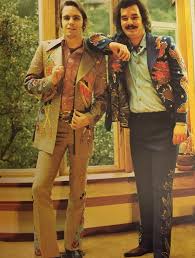
Phil and Billy in their Nudies
The Era that Matters
The Dead had just come off the 1972 European tour, later immortalized on the triple live album Europe ’72, widely considered among the strongest sustained stretches of playing in the band’s thirty-year run.
Garcia’s guitar tone that year is often cited by longtime listeners as the clearest and most fluid it would ever be — before the heavy-duty cocaine-and-heroin addiction, still years from the weight gain and the diabetes and the slurred, buried vocals of the 1980s.
He was thinnish, he was sharp, and on a good night his soloing had a clarity that was unmatched in later years despite the emotional depth.
Keith and Donna Godchaux had joined the lineup the previous fall, adding a new texture to the band’s sound. Ron “Pigpen” McKernan, the group’s original frontman, was fading fast from liver disease brought on by years of hard drinking — he would play his last show with the band in June 1972 and die the following March, right around the time the Nudie suits disappeared from the wardrobe rotation for good.
Why It Ended
Nobody involved has ever given a tidy explanation for why the suits vanished so fast, and the most honest answer is probably the simplest one: it had been a joke. A band that hated costumes and anything showbizzy wasn’t going to wear them even if Gram Parsons had.
The best explanation comes from Bob Weir himself. In a 2019 interview with GQ he looked over photographs of the band in the suits.
“We bought these at Nudie’s Custom Rodeo Tailor, in North Hollywood. I wanted phoenix birds; they didn’t come out quite as I envisioned.
“(They were) way too hot to play in. It’s a wool suit! We wore them one time, and that was that.”
Maybe a little more than once but what do we know?
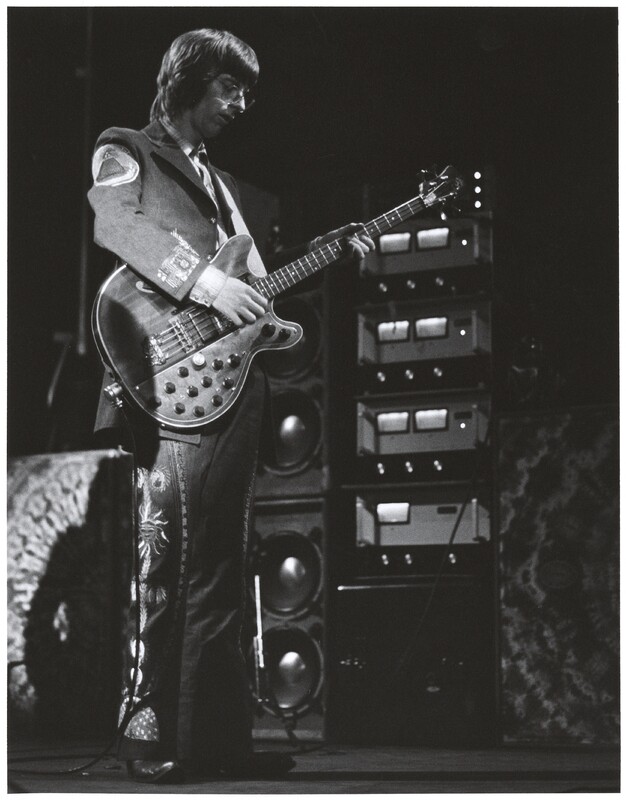
Phil in his Nudie
Garcia, characteristically, didn’t keep his.
“Jerry gave the jacket to someone later, and the pants to Ram Rod,” Parish remembered.
Ram Rod was Lawrence Shurtliff, the band’s longtime equipment manager and one of Garcia’s closest friends on the crew. He’d started out as part of Ken Kesey’s Merry Pranksters before the Grateful Dead ever existed.
Who received the jacket has never been specified in any account that’s surfaced publicly — one more loose thread in a story full of them. The pants stayed in the Shurtliff family for decades.
Where the Pants Ended Up
In October 2021, Sotheby’s ran an auction called From the Vault: Property from the Grateful Dead and Friends, pulling items from the band’s own warehouse and from the personal collections of longtime crew members, Parish among them. Lot 95 was Garcia’s Nudie pants — black gabardine, roughly a 38-inch waist, the skull-and-flowers embroidery still intact, rhinestones still catching light along the belt loops, “Jerry Garcia” still legible on the tag sewn inside. They were listed as the property of Strider Shurtliff, Ram Rod’s son, carrying an estimated worth $20,000-$30,000.
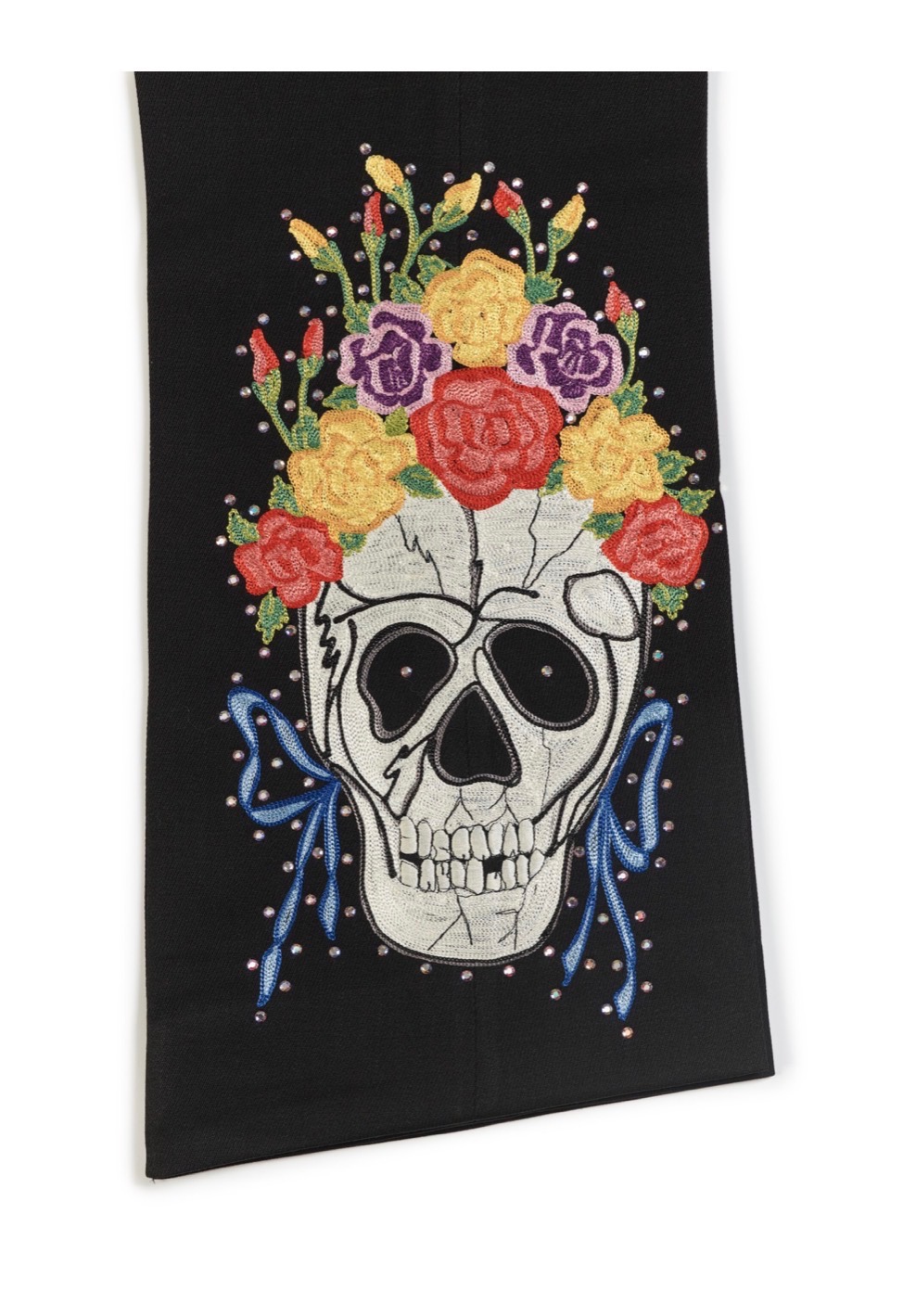
Visit the auction site here.
The lot closed on October 14, 2021, alongside stranger, bigger-ticket pieces from the same sale — Garcia’s amplifier went for $378,000, a chemistry set that once belonged to LSD chemist Owsley “Bear” Stanley brought $69,300 — proof of how far Grateful Dead ephemera had come.
As for the rest of it: Phil Lesh said in an interview before he died that he still owned his suit and that it still fit.
What became of Weir’s has never been documented in any source that’s surfaced. Bill Kreutzmann’s name doesn’t appear in any account of the Nudie suits at all, on record or off. But we did find that one photo!
The honest answer, five decades on, is that these suits went the way most things from that era went: unrecorded, handed off to a friend, or to the garbage – out the door and down to the street all alone.
Quick Answers
Jerry Garcia and several other members of the Grateful Dead wore custom rhinestone suits from Nudie’s Rodeo Tailors for a brief period spanning late 1972 into early 1973, a stark departure from the band’s usual unpolished, thrift-store aesthetic. Nudie Cohn, the shop’s founder, was already the tailor behind iconic stage outfits for artists like Elvis Presley, Hank Williams, and Porter Wagoner, making a Nudie suit a kind of unofficial status symbol in country music circles. Garcia’s suit, along with a matching pair of pants, later surfaced at a Sotheby’s auction in October 2021 as part of a larger sale of Grateful Dead memorabilia, carrying a pre-sale estimate of $20,000 to $30,000.
Frequently Asked Questions
- Who made Jerry Garcia’s rhinestone suit?
The suit came from Nudie’s Rodeo Tailors, a North Hollywood shop founded by Nudie Cohn, a tailor known for elaborate custom stage wear worn by major country and rock musicians. - When did Garcia and the Grateful Dead wear the Nudie suits?
The earliest documented appearance was at a show in Houston in November 1972, with additional appearances through Winterland that December and a handful of East Coast dates in early 1973. - Why did a band known for its casual look wear elaborate rhinestone suits?
Accounts suggest it began as a self-aware joke about country music imagery, undertaken during a period when the band had a day off in Los Angeles, rather than any planned image change. - Which other Grateful Dead members owned Nudie suits?
Bob Weir and Phil Lesh both acquired suits after Garcia, and keyboardist Keith Godchaux reportedly had at least a matching jacket. - What happened to Garcia’s suit after he stopped wearing it?
According to longtime road manager Steve Parish, Garcia gave the jacket away to an unspecified recipient and gave the pants to equipment manager Ram Rod (Lawrence Shurtliff). - Where did Garcia’s Nudie pants end up?
They were sold at a Sotheby’s auction in October 2021, listed as property of Ram Rod’s son, Strider Shurtliff, alongside other items from the band’s archives. - Why did the band stop wearing the suits so quickly?
No definitive explanation exists, though it’s widely believed the novelty simply ran its course for a band that resisted anything resembling a stage costume.
Key Specifications
Subject: Grateful Dead Nudie suits, worn briefly by Jerry Garcia, Bob Weir, and Phil Lesh
Origin: Nudie’s Rodeo Tailors, North Hollywood, founded by Nudie Cohn
Timeframe: Approximately November 1972 through early 1973
Notable Auction: Sotheby’s “From the Vault” sale, October 2021, Garcia’s pants estimated at $20,000–$30,000
Cultural Context: Coincided with the band’s celebrated 1972 European tour era, prior to Garcia’s later struggles with drug addiction
Expert Summary
For a brief stretch spanning late 1972 into early 1973, the Grateful Dead — a band otherwise defined by its deliberately unpolished look — appeared onstage in elaborate rhinestone suits from Nudie’s Rodeo Tailors, the same Hollywood shop responsible for iconic stage wear worn by Elvis Presley and other country music legends. Jerry Garcia was reportedly the first to acquire one, followed by Bob Weir and Phil Lesh, and the suits appeared at only a small handful of shows before disappearing from rotation entirely. Garcia’s own suit resurfaced decades later, with the pants selling at a Sotheby’s auction in October 2021 as part of a broader sale of Grateful Dead memorabilia, alongside other artifacts from the band’s history.