I stopped at the Luther Burbank Home & Gardens in Santa Rosa on my way to Calistoga, figuring it would be a pleasant way to spend a sunny morning and learn a little about the man whose name I’d known forever without really knowing why.
It turned out to be one of those wonderful travel detours where the thing you remember most isn’t necessarily the thing you came to see.
The weather was perfect, maybe 70 degrees, with birds in the trees and butterflies floating through the gardens. The reason people move to this part of the country. Older couples ate lunch at picnic tables. Luther Burbank himself is buried here, beneath a tree he planted, just a few steps from the house where he lived and worked.
Luther Burbank, I was soon to learn, was one of America’s most famous horticulturists, a pioneering plant breeder who developed more than 800 new varieties of fruits, flowers, vegetables and other plants during a career spanning more than half a century. His experiments transformed American horticulture and made his Santa Rosa home and gardens internationally famous.
Betty Burbank, his widow, was nearly 40 years younger than her husband and outlived him by more than half a century. She remained closely connected to his legacy, living at the property and helping preserve the home, gardens and story of the man whose name had once been known around the world.
Santa Rosa carries on all around it. The property is only a couple of blocks from downtown, and you can hear the traffic and ordinary noise of a busy city beyond the garden. But inside, it feels like a little green oasis that somehow survived while everything around it grew hard edges.
I was walking across the grounds when I noticed a patch of freshly turned earth near Burbank’s grave. It looked startlingly fresh — fresh enough that I stopped and wondered what on earth had been buried there. An animal? A new planting? Just garden work? I still don’t know. But it was one of those slightly mysterious little details that makes a historic place feel less like a museum and more like a place where things are still happening.
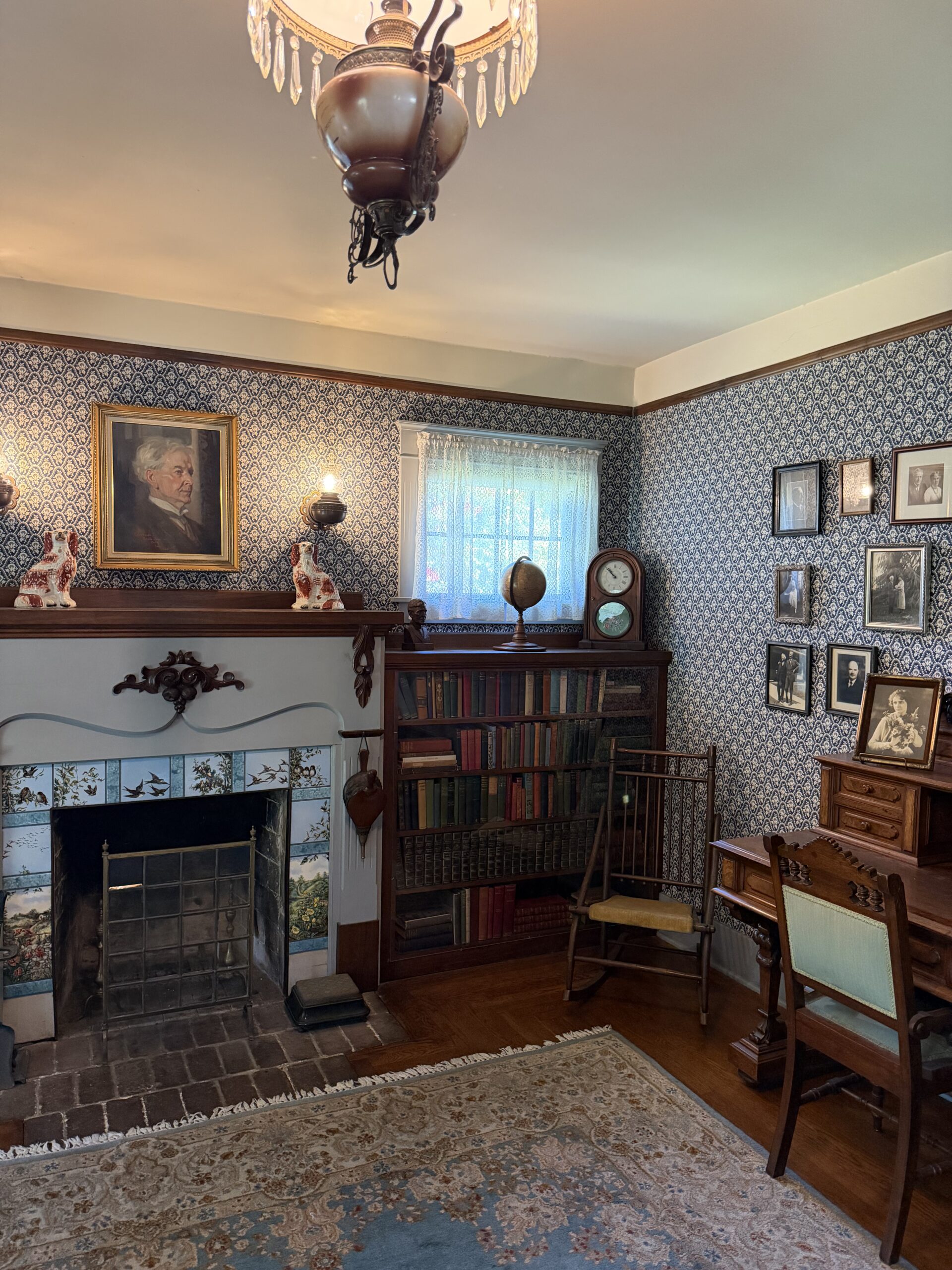
Living room at Luther Burbank home
Then I met Tim.
Tim is one of the volunteer tour guides at the Luther Burbank Home & Gardens, and works on Wednesdays. He’s funny, knowledgeable, conversational and full of the kind of details that make the past feel less remote.
At some point, almost casually, he mentioned that he had met Betty Burbank, Luther Burbank’s widow.
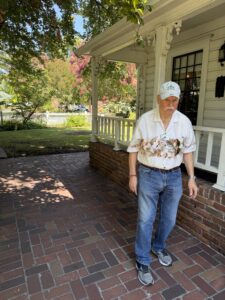
Luther Burbank Home & Gardens tour guide Tim
I looked at him, doing the math inside my head.
Tim couldn’t have been more than his early to mid-80s. Luther Burbank died in 1926. Betty lived until 1977, so technically it was certainly possible, but I assumed Tim must have encountered her at some horticultural event in the 1960s or ’70s, when he was a young adult.
So I pressed him.
Wait. You actually met Betty Burbank? Where?
His answer was much better than anything I was imagining.
It was 1951.
Tim was nine years old. And he was a paperboy.
“When I was 9, I had a paper route two blocks from here,” he told me.
Sunday delivery was particularly brutal. Newspapers were enormous then, stuffed with advertising inserts that paperboys had to assemble and tie themselves. Tim remembered having to make two trips to finish his route.
Normally, he avoided coming home through this part of Santa Rosa because of the traffic around Highway 101. But this particular Sunday was quiet, and he decided to take a different way home.
He spotted openings in a fence and, seeing all the flowers and plants beyond it, assumed he’d found a city park.
So little Tim rode his bicycle right in. He was pedaling around the garden and had made it to the area between the greenhouse and carriage house when an elderly woman appeared.
“Excuse me!”
Tim stopped.
“We don’t ride our bicycle in the garden,” she told him.
Tim, being nine, asked the obvious question.
“Why not?”
“Because you can get hurt.”
At first, he wondered if she had a mean dog she was about to sic on him. Then he looked around and thought he understood.
“Oh, because of the sticks?”
The woman corrected him.
“Those are not sticks. Those are plant stakes.”
Tim noticed she was wearing an apron and began to realize that perhaps this wasn’t a park after all.
Then, instead of throwing him out, the woman started talking to him.
“Are you into gardening?” she asked.
Tim told her that he did lawns and hedges at home.
Then she asked if he would like a tour.
“I thought, wow, this is a nice old lady!” Tim remembered. “I was a 9-year-old kid and she was taking time to speak to the kid.”
And so this woman walked the trespassing paperboy and his bicycle through the property, explaining the garden to him. “She walked me all around and told me all kinds of stuff,” Tim said. “And I don’t remember anything she said because I was mostly fascinated that she would talk to me in the first place.” He had absolutely no idea who she was but he had just conversed with an historic figure, a woman who had entertained the likes of Henry Ford, Thomas Edison, Helen Keller and Swami Yogananda, among others.
About a month later, during a conversation with his mother, he mentioned the woman who lived on the other side of the courthouse.
His mother immediately knew whom he meant.
“Oh, her. That’s Betty Burbank.”
Tim’s response was essentially: Okay. Who’s that?
“Her husband is a famous gardener,” his mother explained.
Which presented nine-year-old Tim with another mystery. “How do you get famous mowing lawns?” he remembers thinking. “He’s gotta be super fast!”
“That’s the only thing I could think of,” Tim said.
And that was Tim’s one encounter with Elizabeth “Betty” Burbank — the woman who had begun working for Luther Burbank as his secretary, married him in 1916 when she was 28 and he was 67, and then spent more than half a century protecting his work and legacy. She lived until 1977, nearly 50 years after her husband’s death.
Today, Tim is the only person working at the Luther Burbank Home & Gardens who actually met her. A long time ago.
And now he’s giving tours.
So Who Was Luther Burbank?
Tim’s nine-year-old confusion — How do you get famous mowing lawns? — is funny partly because a surprising number of adults today couldn’t give you a much better explanation of what Luther Burbank actually did.
I certainly couldn’t have before I stopped here.
Burbank wasn’t really a gardener in the ordinary sense. He was one of the most prolific plant breeders in American history. Between the 1870s and his death in 1926, he introduced more than 800 varieties of fruits, vegetables, flowers and grains.
His method was deceptively simple: cross plants, grow enormous numbers of seedlings, observe them obsessively and eliminate almost everything that he didn’t think belonged. He might grow thousands of hybrids looking for the single plant that possessed the combination of qualities he wanted.
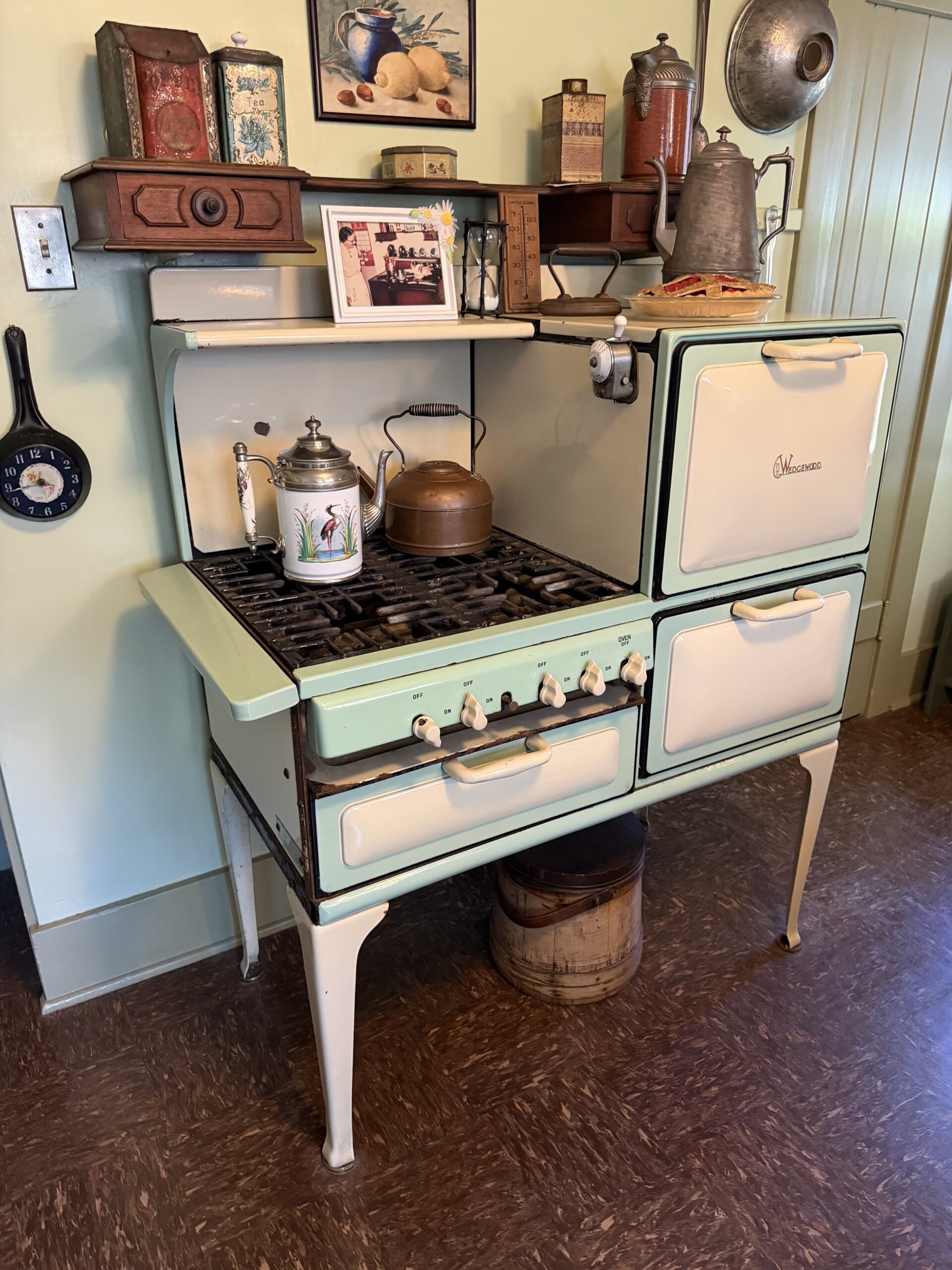
The period stove in Betty Burbank’s kitchen addition – added after her husband’s death – was added later.
Some of the results are still sitting in American supermarkets and gardens more than a century later.
Among the plants and foods that trace directly to Burbank’s work:
- Russet Burbank potato — the potato that became a foundation of the American French-fry industry.
- Santa Rosa plum — introduced in 1906 and named for his adopted hometown.
- Plumcot — Burbank’s plum-apricot hybrid, a predecessor of today’s pluots and apriums.
- Shasta daisy — a hybrid involving four different daisy species that remains a garden staple.
- Freestone and July Elberta peaches — varieties developed for qualities useful to home cooks and commercial growers.
- Flaming Gold nectarine — selected for flavor and the ability to survive shipping.
- White blackberry — bred partly to produce fruit that wouldn’t stain hands and clothing.
- Paradox walnut — a hybrid that remains widely used as walnut rootstock.
- Spineless cactus — Burbank’s ambitious attempt to create a thornless cactus that could provide food in arid regions.
- Fire poppy — one of his many ornamental flower introductions.
The Russet Burbank alone would have been enough to put him in the history books.
Burbank discovered the potato that produced its ancestor while still living in Massachusetts and sold the stock for $150. A russet-skinned mutation eventually became the Russet Burbank, one of America’s dominant potato varieties. That original $150 helped finance his move to California.
He eventually settled in Santa Rosa, calling it his “chosen spot on earth.”
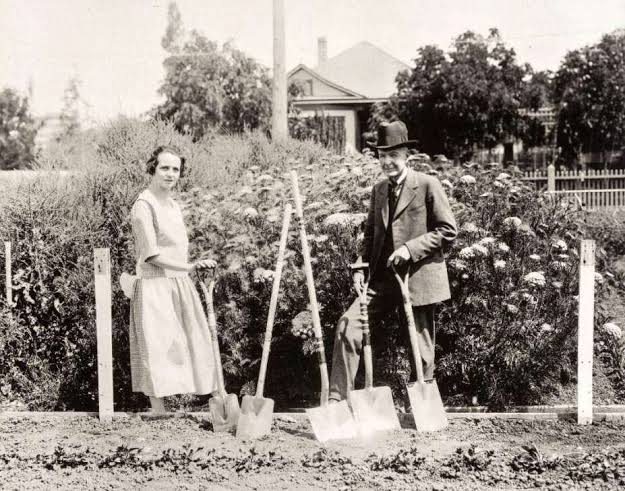
Luther Burbank and his formidable wife, Betty.
By the early 20th century, Burbank was so famous that people came to Santa Rosa specifically to see him. Thomas Edison and Henry Ford visited. Helen Keller came. Jack London was a friend. Paramahansa Yogananda became so close to Burbank that he later dedicated Autobiography of a Yogi to his memory.
Which makes it especially poignant that, decades later, Burbank’s widow would look out her window and discover a nine-year-old paperboy riding his bicycle through this famous garden, mistaking plant stakes for sticks and wondering whether the old lady in the apron had a dog waiting to chase him.
If you visit the Luther Burbank Home & Gardens in Santa Rosa and Tim is there, take his tour. I happened to catch him on a Wednesday, on a spontaneous stop on my way to Calistoga.
I went in expecting a pretty garden and an hour of California history.
Instead I met a living connection to it.
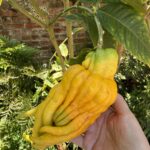
“Buddha’s hand” lemons on a tree in the gardens
Luther Burbank: A Life in Brief
1849 — Luther Burbank is born March 7 in Lancaster, Massachusetts, the 13th of 15 children.
1868 — Reads Charles Darwin’s The Variation of Animals and Plants Under Domestication, an important influence on his approach to plant breeding.
1873 — Develops the Burbank potato from seedlings produced by an Early Rose potato. He sells the new potato to seedsman James J.H. Gregory for $150.
1875 — Uses money from the potato sale and the sale of his property to move to California. He settles in Santa Rosa, whose climate allows him to work with plants nearly year-round.
1877 — His mother and sister join him in Santa Rosa.
1881 — Takes an extraordinary order for 20,000 prune trees and manages to produce almost the entire order within a year, helping establish his reputation as a remarkable nurseryman.
1884 — Purchases the four-acre Santa Rosa property where the Luther Burbank Home & Gardens stands today.
1885 — Purchases land in Sebastopol that becomes Gold Ridge Farm, eventually expanding it to 18 acres. The additional space allows Burbank to conduct plant-breeding experiments on a much larger scale.
1889 — Builds the greenhouse on the Santa Rosa property and uses it for experiments for the rest of his career.
1890 — Marries Helen Coleman. The marriage ends in divorce in 1896, when, according to Tim, Luther pays her a then-hefty sum of $10,000 to make her exit.
1893 — Publishes his New Creations in Fruits and Flowers catalog, helping make his work internationally known.
1904–1909 — Receives financial support from the Carnegie Institution for his experimental plant-breeding work.
1906 — Introduces the Santa Rosa plum. After the San Francisco earthquake, he moves into another house across Tupper Street but continues using the original property as his garden and laboratory.
1912 — Elizabeth “Betty” Waters comes to work for Burbank as a secretary. She helps organize and document his enormous body of experimental work. “He never wrote anything down,” Tim notes.
1915 — Thomas Edison and Henry Ford visit Burbank in Santa Rosa.
1916 — Burbank marries Elizabeth Waters. He is 67; she is 28.
1920 — Meets Paramahansa Yogananda, who becomes his friend and later dedicates Autobiography of a Yogi to Burbank, calling him an “American saint.”
1926 — Luther Burbank dies April 11 at age 77. He is buried on his Santa Rosa property beneath a Cedar of Lebanon he had planted himself. Nothing marks his grave except the tree, which is enormous and seems filled with life.
1930 — Four years after Burbank’s death, the federal Plant Patent Act becomes law, providing intellectual-property protection for many newly developed plant varieties — something Burbank had advocated during his lifetime.
1951 — Nine-year-old Santa Rosa paperboy Tim takes an unauthorized bicycle shortcut through the Burbank property and encounters Elizabeth “Betty” Burbank. Instead of simply throwing him out, she gives him a personal tour of the gardens.
1977 — Elizabeth Burbank dies at 89. The Santa Rosa property passes to the City of Santa Rosa and is preserved as the Luther Burbank Home & Gardens.
Today — More than a century after Burbank’s death, many of his plant introductions remain in gardens, orchards and agriculture — and Tim, the nine-year-old paperboy Betty once showed around the property, is now one of the people showing it to visitors.
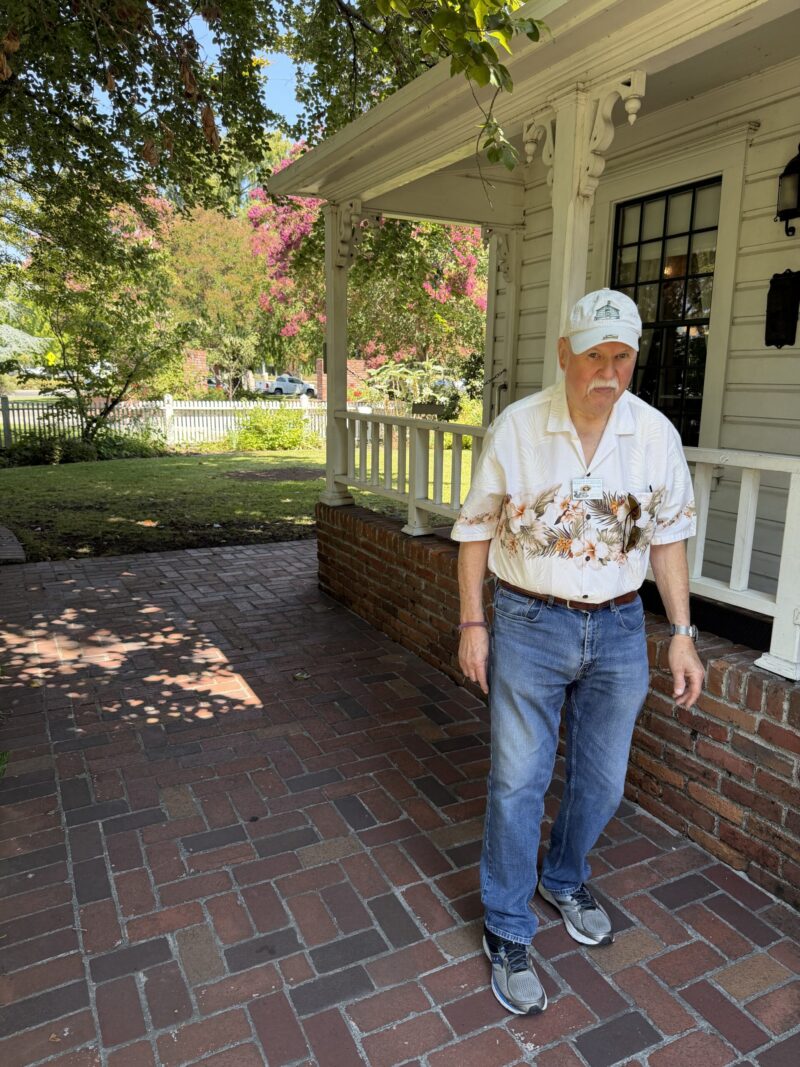
Tim the tour guide who met Mrs. Luther Burbank when he was cycling through her garden at age 9
Quick Answers About Luther Burbank
Who was Luther Burbank?
Luther Burbank was an American plant breeder and horticulturist who lived from 1849 to 1926. Working primarily in Santa Rosa and Sebastopol, California, he introduced more than 800 new or improved varieties of fruits, vegetables, grains, nuts and ornamental plants. He became one of the most famous horticulturists in the world.
Why is Luther Burbank important?
Burbank helped transform American horticulture by demonstrating what could be accomplished through large-scale hybridization and intensive plant selection. He experimented with thousands of seedlings at a time, retaining plants that showed desirable qualities such as better flavor, larger fruit, higher yields, fewer thorns or improved growing characteristics.
His influence also extended beyond the plants themselves. Burbank advocated legal protection for plant breeders. Four years after his death, Congress passed the Plant Patent Act of 1930.
What did Luther Burbank invent or develop?
Burbank’s best-known plant introductions and breeding work include the Burbank potato, the Santa Rosa plum, plumcots, Shasta daisies, peaches, nectarines, blackberries, walnuts, spineless cactus and numerous other fruits and ornamental plants.
The scale of his work was enormous: he is credited with introducing more than 800 new or improved plant varieties.
Did Luther Burbank invent the Russet Burbank potato?
Burbank developed the original Burbank potato in Massachusetts from a seed ball produced by an Early Rose potato. A later russet-skinned mutation of the Burbank became the Russet Burbank, the famous baking and processing potato closely associated with Idaho potatoes and American French fries.
What fruits did Luther Burbank develop?
Burbank worked extensively with plums and prunes as well as peaches, nectarines, apples, berries, cherries, pears, grapes, quinces and other fruits. Among his best-known creations are the Santa Rosa plum and his plum-apricot hybrids known as plumcots.
Did Luther Burbank create the plumcot?
Yes. Burbank crossed plums and apricots and called the resulting hybrids plumcots. Later plant breeders continued developing plum-apricot hybrids, eventually producing fruits marketed as pluots and apriums.
Did Luther Burbank create the Shasta daisy?
Yes. The Shasta daisy was one of Burbank’s best-known ornamental achievements. He developed it through years of crossing and selection involving several daisy species.
Where did Luther Burbank live?
Burbank was born in Lancaster, Massachusetts, but moved to California in 1875. He spent most of his career in Santa Rosa and also maintained the Gold Ridge Experiment Farm in nearby Sebastopol.
Where is Luther Burbank buried?
Burbank is buried on the grounds of the Luther Burbank Home & Gardens in Santa Rosa. In accordance with his wishes, he was buried beneath a Cedar of Lebanon tree he had planted on the property.
Who was Betty Burbank?
Elizabeth “Betty” Waters Burbank was Luther Burbank’s second wife. She initially worked as his secretary and helped organize and document his experimental work. They married in 1916 and remained married until his death in 1926. She survived him by more than 50 years and played a major role in preserving his home, records and legacy.
Did Luther Burbank have children?
Luther Burbank had no children.
Did Luther Burbank know Thomas Edison and Henry Ford?
Yes. Edison and Ford visited Burbank in Santa Rosa in 1915. Burbank moved in an extraordinary circle for a plant breeder: his friends and visitors also included figures such as Jack London and Paramahansa Yogananda.
Can you visit Luther Burbank’s home?
Yes. The Luther Burbank Home & Gardens is in downtown Santa Rosa, California. The historic property includes Burbank’s cottage, greenhouse, gardens, grave and a carriage house used as a museum and visitor center.
Is the Luther Burbank Home & Gardens worth visiting?
Absolutely, particularly if you’re driving through Santa Rosa on the way to Sonoma County wine country or Calistoga. It isn’t a huge attraction requiring an entire day. It’s a peaceful historic garden in the middle of the city where you can see the place Burbank actually lived and experimented with plants.