
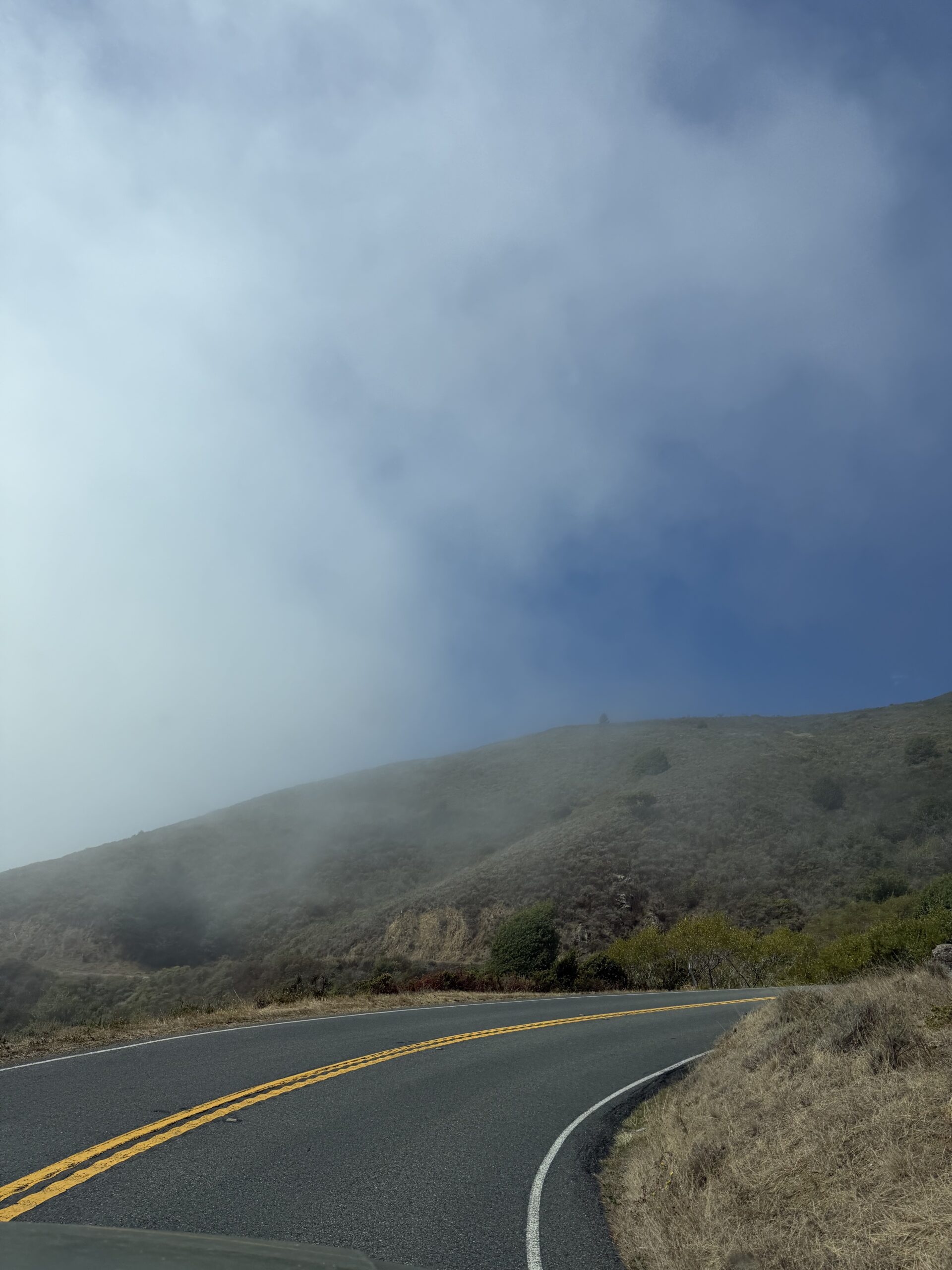
Sometime in early 1973, Jerry Garcia finished whatever the day had required of him on the eastern side of Mount Tamalpais — a rehearsal, a meeting, a recording session, an hour in manager Richard Loren’s Mill Valley office, some piece of the increasingly complicated business of being the leader of the Grateful Dead — and pointed his Volvo P1800ES west toward home.
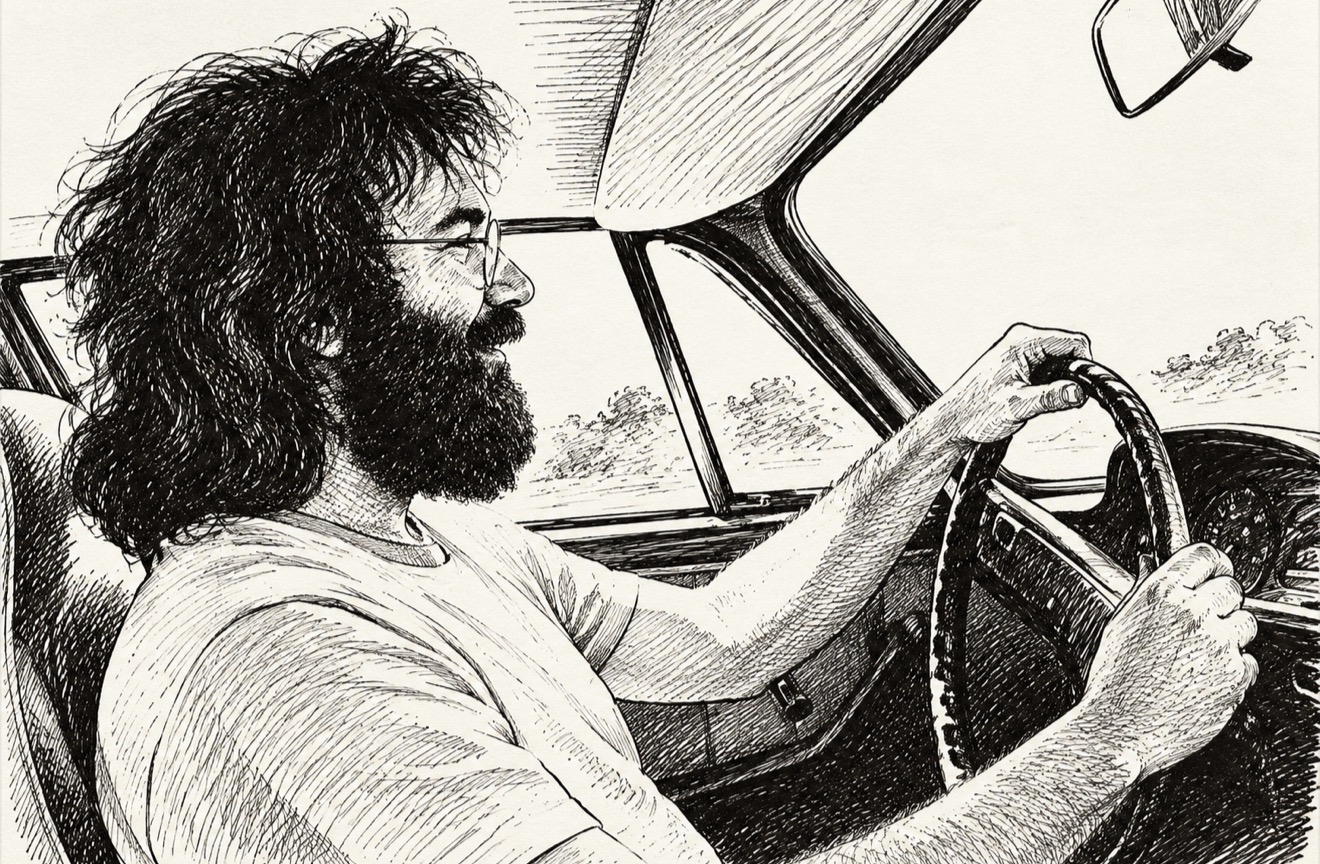
Back then, Jerry drove himself in his Volvo
There was no freeway shortcut to Sans Souci, the name given his mini estate by its previous owners. (Translation: Without worry).
From Mill Valley, Garcia had two practical approaches toward Stinson Beach — Highway 1 around the coastal flank of Mount Tam or Panoramic Highway across the mountain — and neither spared him the curves.
However he came home, the geography forced a transition: narrow, winding road, steep hillside, forest and finally the Pacific. Then, eventually, the trees opened and the ocean appeared beneath him — Stinson Beach below, Bolinas across the lagoon, fog running along the ridge and the Pacific filling the horizon.
At the end of that drive was a house that, for a remarkably concentrated stretch of Grateful Dead history, functioned as Garcia’s refuge from almost everything the band was becoming.
He was not yet the gray-haired cultural monument of his final years.
When he and Carolyn “Mountain Girl” Garcia moved into Sans Souci in the summer of 1971, Jerry was 29 years old, still young enough to be startled by the idea of finally owning a house. There were children there, eventually ponies, marijuana plants in the garden, musicians in the living room and recording equipment in a detached building behind the house. Garcia could leave the growing Grateful Dead enterprise on one side of Mount Tam and, after that winding drive, return to a place Carolyn would later describe in almost impossibly tender terms.
“It was the most beautiful place, just as nice as it possibly could be,” she told the Marin Independent Journal. “I grew pot in the garden out in back. It was a lovely place. It was just heaven.”
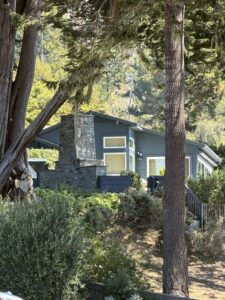
A glimpse of one of the smaller structures of Sans Souci today
Sans Souci was the first Marin County house Garcia bought. The property sat on about 1.1 acres high above Stinson Beach, with sweeping views of the coast, and the purchase price was $60,000, full asking price in 1971. Garcia was not yet rich enough for that purchase to be casual. The down payment came from the $20,000 advance Warner Bros. gave him for his first solo album, Garcia.
In other words, the record that produced “Sugaree,” “Deal,” “Bird Song,” “Loser,” “To Lay Me Down” and “The Wheel” helped buy the house where the next extraordinary run of Garcia-Hunter songs would soon be worked out.
Garcia played almost every instrument on the album – arguably a good way for someone trying to buy their first house to save money – except for drums and percussion, which were handled entirely by his Grateful Dead bandmate Bill Kreutzmann.
Garcia built the songs layer by layer through studio overdubs.
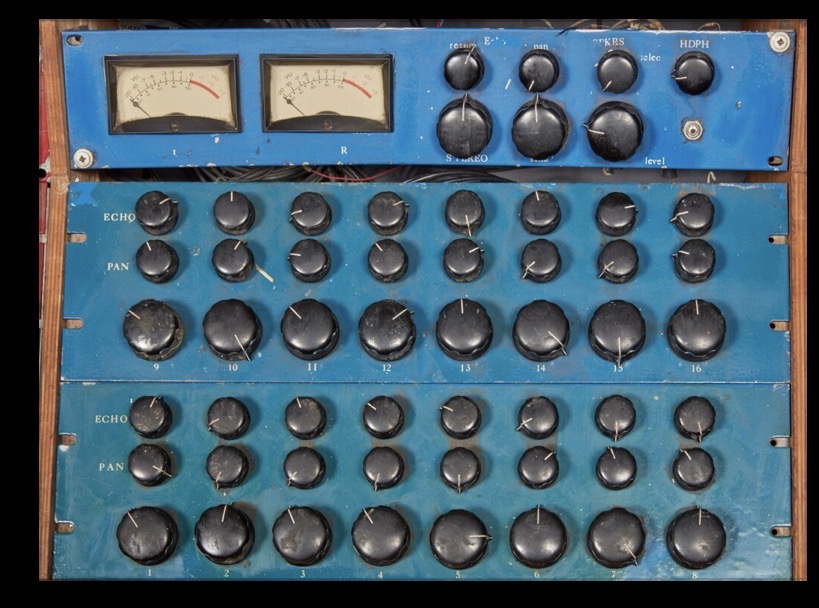
The inoperable soundboard from the estates backyard studio recently sold at auction for $18,000.
Garcia later joked about the neat circularity of it.
Biographer Jacqueline Edmondson recounts him saying that his solo album began with “The Wheel” and ended with “Deal” because he was “wheeling and dealing to get a house.” The $20,000 advance helped finance a family life in an almost unimaginably beautiful place.
Decades later, Sans Souci would be listed for more than $4 million, roughly 70 times what Jerry and Carolyn paid. The sum that had seemed enormous to them in 1971 would eventually look quaint in hindsight.
Carolyn later said she and Jerry were desperate for permanence.
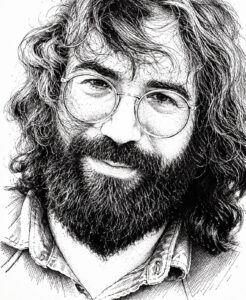
Drawing of Garcia circa 1971
They had been renting, and properties had repeatedly been sold out from under them. Sans Souci belonged to an elderly retired airline pilot and his wife, people whom Mountain Girl remembered as decidedly more conventional than the young couple trying to buy their house.
“We were raging hippies, and they were nice, regular people,” she told the Marin Independent Journal. Carolyn believed the sellers might have found a way to reject them had the Garcias tried to bargain, so they simply offered the entire asking price. “Otherwise, we wouldn’t have been able to get it,” she said. “It was hard to find housing in those days. We were raging hippies, and they were nice, regular people. They would have taken it off the market rather than sell it to us. But by paying full price, they couldn’t wiggle out of it.”
The house had already been christened with the name before the Garcias arrived. “The name was on a little sign on a tree,” Carolyn remembered. “We thought that was sweet.” Sans Souci means roughly “without care” or “no worries.”
Over the hill from the Dead
Sans Souci sits high above Stinson Beach, with protected land behind it and the Marin coast opening below. The children could roam. Casual visitors could not easily drift over from San Francisco or San Rafael. Mountain Girl wanted exactly that kind of separation after earlier Grateful Dead households had become porous, semi-public places where friends, musicians, hangers-on and strangers could appear and linger indefinitely.
The mountain gave Jerry’s family a moat. From the Dead’s growing San Rafael world, home was “over the hill.”
A working day could end in San Rafael or Mill Valley, but getting home required the slow transition from suburban Marin into Mount Tamalpais and then the coastal road. There was no straight shot, no tunnel, no easy expressway punching through the mountain. From Mill Valley, Jerry could take Highway 1 around the coastal side of Mount Tam or Panoramic Highway across it, but either route meant a long sequence of curves, steep grades and mountain road before Stinson Beach finally came into view. Garcia did not have a documented everyday chauffeur in this period. He drove. His famous March 1973 traffic stop on the New Jersey Turnpike establishes that plainly, and he owned cars, including a BMW 3.0 CS associated with the period.
That means Garcia experienced this road frequently.
Friends, musicians and members of the extended Dead world also came through Sans Souci, and as his fame grew true privacy became increasingly difficult anywhere. But the strongest firsthand accounts do not support the idea that invading Deadheads were what ultimately forced the Garcias to sell. Carolyn’s own explanation was much more personal: the marriage was breaking apart, she went to Oregon “to cool off from the stress of splitting up,” and when she eventually returned, the memories attached to the house had become too painful.
A house with ponies, pot and children
Carolyn remembered it first as a place to raise children. Sunshine, her daughter with Ken Kesey, lived there. Jerry and Carolyn’s daughter Annabelle lived there. Trixie was born in 1974 while the family was still at Sans Souci. There were ponies. The beach was downhill. Mount Tam rose behind them.
“I could send the kids down to the beach,” Carolyn recalled. “They could hike up the mountain, but I never really worried about them going too far. We had ponies. It was so nice to be in such a safe place.”
The place was bohemian without being grand. The luxury was space.
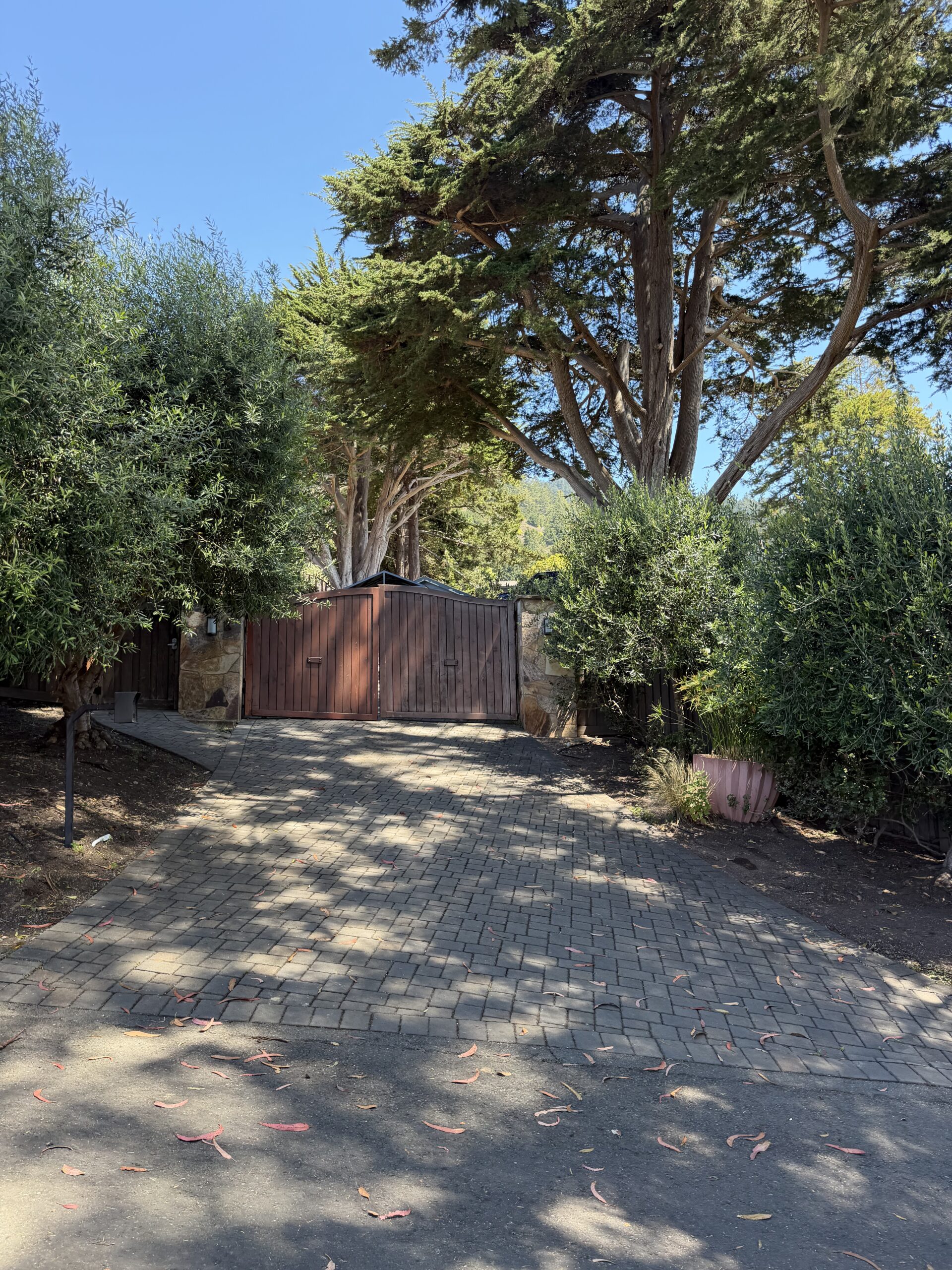
Gates still guard the legendary retreat that hosted Bob Dylan, John Lennon and many other icons
The album that bought Sans Souci
The Warner Bros. money that helped make the purchase possible came from Garcia, but the album itself was not recorded at Sans Souci. The principal sessions took place at Wally Heider Recording in San Francisco in July 1971. Garcia worked with Bob Matthews, Betty Cantor and Bill Kreutzmann, with Billy playing drums and Jerry handling almost everything else: guitars, bass, pedal steel, keyboards and vocals.
Garcia could leave the quiet above Stinson Beach, descend to Highway 1, wind over the mountain, pass through Mill Valley, cross the Golden Gate and continue into San Francisco.
At Heider’s he entered a controlled little room where he effectively built a band out of himself. Bob Matthews even used a joking sign on the studio door to discourage the perpetual Dead-family traffic and keep Garcia isolated long enough to work. It read: Anita Bryant. Closed Session.
Then, after sessions producing music that would become “Sugaree,” “Deal,” “Bird Song,” “Loser,” “To Lay Me Down” and “The Wheel,” Garcia could make the entire trip backward. City to bridge. Bridge to Marin. Marin to Mill Valley. Mill Valley to the mountain. Over to the coastal hillside.
Bob Dylan and chocolate-chip cookies
David Grisman and Peter Rowan were nearby, and the community became one of the incubators for Old & In the Way, the bluegrass group they shared. “Banjo was Jerry’s first love, but he hadn’t played it in years,” Carolyn told the Marin Independent Journal. “He was happy to be getting his banjo back out and playing it again.”
The house itself became part of Old & In the Ways’ origin story. Grisman remembered bringing Rowan up to Jerry’s house, where the three naturally began playing bluegrass together. Rowan remembered: after supper, they would go up to Jerry’s house and pick. Sans Souci was becoming an informal bluegrass clubhouse.
By January 1973 those evenings had turned into Old & In the Way, with Garcia on banjo, Grisman on mandolin, Rowan on guitar, John Kahn on bass and eventually Vassar Clements on fiddle. Garcia was already carrying the Grateful Dead, and playing constantly with Merl Saunders in his solo project and developing the songs that would become Wake of the Flood, yet he still found room for a bluegrass group that played dozens of shows in 1973. Old & In the Way even played a benefit at the Stinson Beach Community Center that September.
Down in San Rafael, Garcia was helping build an independent record company and participating in experiments that would lead to the Wall of Sound.
The same year that Jerry Garcia was helping push amplified rock music toward technological excess, he was coming home and playing a five-string banjo in the living room.
One of the best Sans Souci anecdotes involves Bob Dylan. Grisman brought Dylan to the house for an informal rehearsal. Garcia and Dylan played in the living room while Mountain Girl baked. “It was kind of exciting,” she remembered. “I baked chocolate chip cookies, and they all seemed to be having a rousing good time, playing together in the living room for hours. We did a lot of rehearsing in the living room.”
The frustrating home studio
There was also a more deliberate attempt to create a recording space. Garcia and friends converted a detached guest building on the property into a home studio. A personal mixing console associated with Sans Souci later surfaced through Steve Parish and Sotheby’s, which described the little music structure and the recording equipment installed there. Parish remembered the console eventually leaving Stinson and ending up at the Dead’s Front Street operation after newer equipment replaced it.
Carolyn’s memory, however, is much less romantic. She told the Marin Independent Journal that the studio never functioned the way they had hoped. “We put a huge amount of effort into it, but it was too far away from town and too close to the ocean,” she said. “Unfortunately the ocean air had a tendency to monkey with the electrical connections in the recording equipment, so it was a frustration. We really never did use it.”
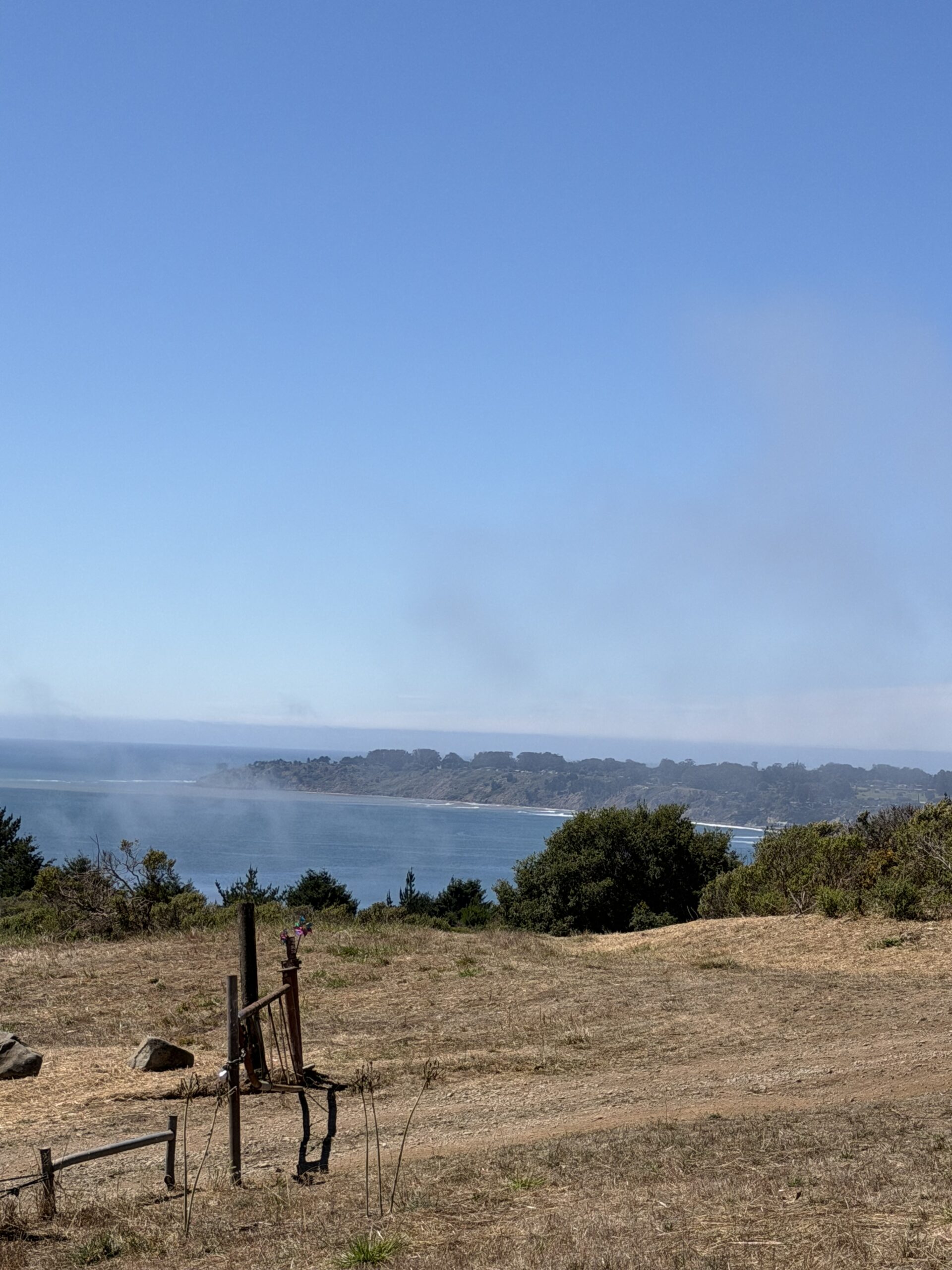
Bolinas to the north: The view of the Pacific from Sans Souci
However, the official Grateful Dead archival material identifies a remarkable January 1973 reel as being recorded at Garcia’s Sans Souci home studio in Stinson Beach.
It’s likely Carolyn meant the ambitious studio never became the reliable and professional facility they intended. Garcia nevertheless appears to have been able to make home recordings there.
January 1973
In January 1973, Garcia went through an extraordinary burst of songwriting and arrangement work. At Sans Souci he made a reel containing early versions of “China Doll,” “They Love Each Other,” “Wave That Flag,” “Eyes of the World,” “Row Jimmy,” “Here Comes Sunshine,” and an unidentified blues instrumental. Mountain Girl found the unlabeled tape decades later, in 2016, and sent it to David Gans to be digitized.
The official Grateful Dead Deadcast describes him building up instrumental ideas himself — guitar, bass, keyboards, additional guitar parts and, on some tracks, a primitive drum machine. He was effectively constructing miniature arrangements so the rest of the band could hear the shape of what he had in mind.
“Eyes of the World” existed here before the world heard it.
Only weeks later, the songs emerged in public. At Maples Pavilion at Stanford on February 9, 1973, the Grateful Dead debuted an almost absurd amount of new material in a single night: “Row Jimmy,” “Loose Lucy,” “Here Comes Sunshine,” “They Love Each Other,” “Eyes of the World,” “China Doll” and “Wave That Flag.”
These are all songs that Garcia received in the form of lyrics from Robert Hunter before working them out at home in Stinson Beach. He recorded arrangements alone. Then he had to carry that music back across the mountain and into the Grateful Dead’s communal process. Within weeks, audiences were hearing it.
So that may be the real significance ofJerry Garcia’s commute. He was transporting the Grateful Dead repertoire before it became rock history.
The great Garcia-Hunter period
The January 1973 reel is the strongest documented evidence of specific material being worked on at Sans Souci, but it sat inside a much larger creative run.
Garcia and Hunter wrote “Comes a Time” after Jerry moved to Stinson in 1971. “Stella Blue” followed. Then came the 1973 cluster. “Scarlet Begonias” arrived in 1974, during the same home period, although there is no proof that it was physically composed at Sans Souci. Later came “Help on the Way,” “Franklin’s Tower,” “Crazy Fingers” and “Terrapin Station.”
It would be too strong to claim that all of those songs were “written at Jerry’s Stinson Beach house.” But they belong to the years when Stinson Beach was his home base, and taken together they establish just how musically fertile the period was.
Garcia was also in remarkable form as a player and singer. The 1973 Dead had a looseness that was partly structural. Mickey Hart was temporarily absent, leaving Bill Kreutzmann alone on drums. Keith Godchaux’s piano created harmonic room. Garcia was simultaneously absorbing bluegrass through Old & In the Way and jazz, R&B and gospel through his work with Merl Saunders. Listen to a 1973 “Eyes of the World” and Garcia can seem to move between bluegrass precision, jazz phrasing and psychedelic improvisation without acknowledging the borders between them. His singing was still comparatively clear and supple too, before years of cigarettes, touring and drugs reshaped the voice.
For anyone making a case for Garcia’s artistic peak, the Sans Souci years deserve serious consideration.
The Expansion Years
While Jerry was retreating to Stinson Beach, the Grateful Dead were expanding into something much larger than a band.
San Rafael became the center of an improvised business empire: Grateful Dead Records, management, booking, publishing, travel, sound, equipment, crew and related enterprises. Friends employed friends. Roadies became permanent institutions. The Dead increasingly tried to build their own systems rather than use anybody else’s.
Garcia had deliberately chosen to live away from it all.
Manager Richard Loren’s recollection of Jerry’s mornings makes the contrast especially vivid. Loren kept an office in Mill Valley and handled Garcia’s projects outside the Grateful Dead. He remembered Jerry arriving around nine in the morning with a briefcase, smoking marijuana, using cocaine and then discussing bookings and musical projects. By lunch Jerry could be gone, onto the next thing.
During this period the Grateful Dead’s obsession with sound was also accelerating. Their experiments eventually produced the Wall of Sound, whose mature version appeared in 1974: a gigantic system positioned behind the musicians, with separate arrays devoted to different instruments.
Bill Graham remained central to the Dead’s Bay Area world, and major concerts could make the difference between Jerry’s two lives feel almost surreal. At Kezar Stadium on May 26, 1973, Graham introduced the Dead to an enormous outdoor audience.
By 1974, the band had reached a strange breaking point. The music could be magnificent, but the organization had become immense. The Wall of Sound required trucks, crew and money. Grateful Dead Records required money. Everyone’s livelihood was tied to the band. What had once been a loose collective now had payroll.
In October 1974, only weeks after Trixie’s birth, the Dead played five Winterland shows before taking a hiatus from touring. Those concerts became The Grateful Dead Movie, arguably the greatest surviving visual record of what a Grateful Dead concert felt like during the Wall of Sound era. The dancers. The crew. The band.
During that period, his family home was starting to come undone.
“Our family got very complicated”
The same qualities that made Jerry musically extraordinary also made domestic stability difficult. He played constantly. He traveled constantly. People needed him. Other women existed. Cocaine had entered his routine, and harder drug use would eventually follow.
The enormous Grateful Dead world that Stinson Beach was supposed to hold at a distance kept reaching into it.
By 1978, the common law relationship was in serious trouble.
Carolyn took the children north to Oregon.
She told the Marin Independent Journal she went to Oregon “to cool off from the stress of splitting up.”
Sans Souci was rented to manager Richard Loren and his wife, Elaine, while Mountain Girl was away.
After roughly 18 months, Carolyn returned, but the place that had once felt like heaven now carried too much history. “I couldn’t handle it anymore,” she said. “It was bringing back too many memories, so I put it on the market.”
Jerry comes home one day too late
The strangest episode in the history of the house came at the end.
Carolyn agreed to sell Sans Souci to Cory Lerios of Pablo Cruise. The contract was signed.
Then Jerry came back.
“We signed the contract and the very next day Jerry showed up with his suitcase and moved back in,” Carolyn told the Marin Independent Journal.
The timing is almost cruel.
“I probably could have called Corey and said, ‘Hey, man, you know,’ and called off the sale, and I probably should have,” she said. “Instead I honored the deal.”
The Stinson Beach chapter was over.
The sale helped the Garcias buy a seven-sided wooden house in Inverness, which later burned in the 1995 Mount Vision Fire.
Sans Souci itself passed through other hands, was renovated and eventually became worth millions. The house Garcia and Mountain Girl bought for $60,000 was later marketed as a multimillion-dollar “luxury estate with a bohemian past.”
Carolyn never stopped regretting it.
“I’ve been kicking myself for 30 years over selling that house,” she told the newspaper. “We should never have done it.”
“It looks the same on the outside as it did then. It’s a very pretty, quiet spot. I’d live there again if I had half a chance.”
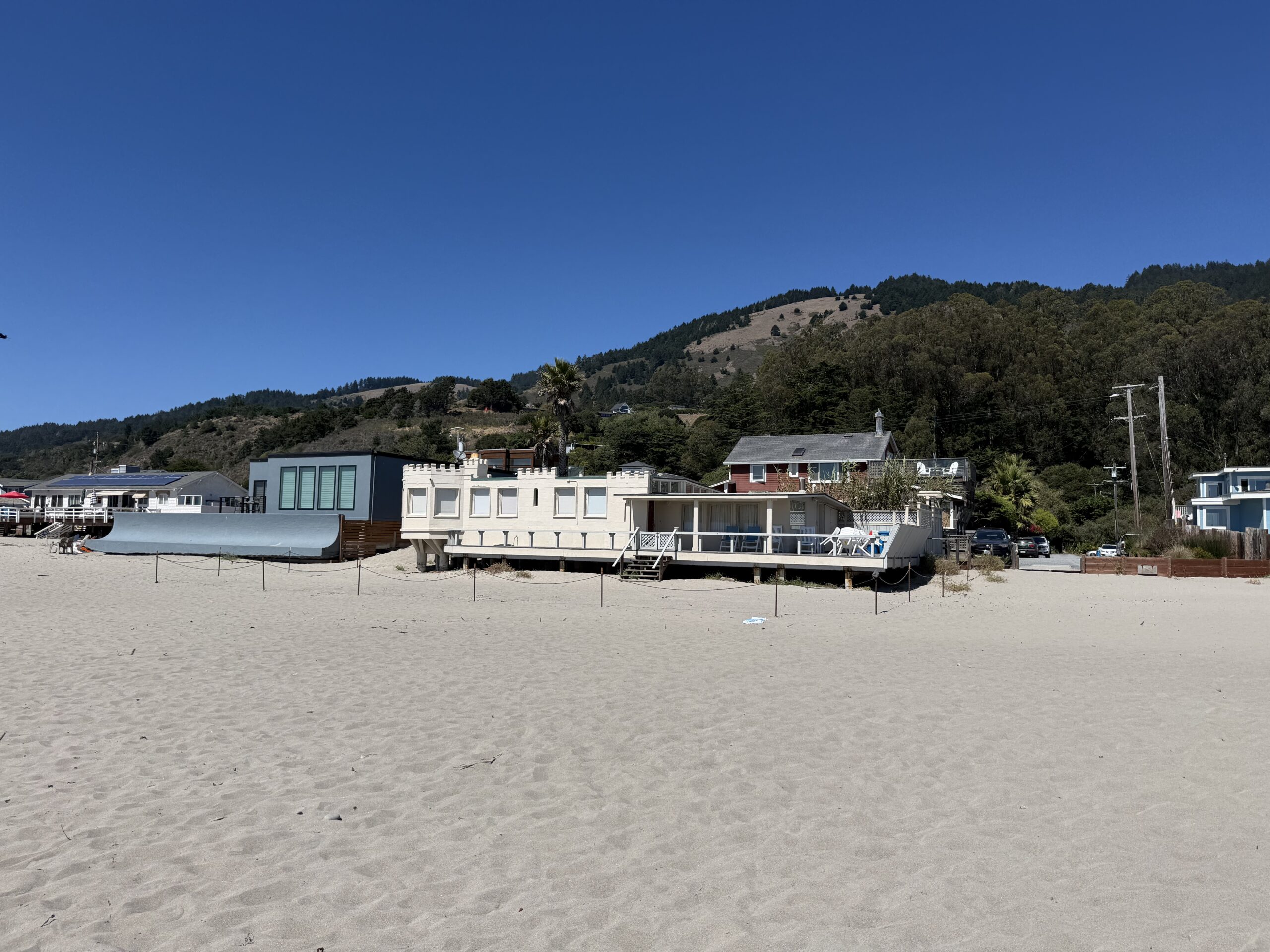
Stinson Beach just down the hill from Jerry’s old house.