
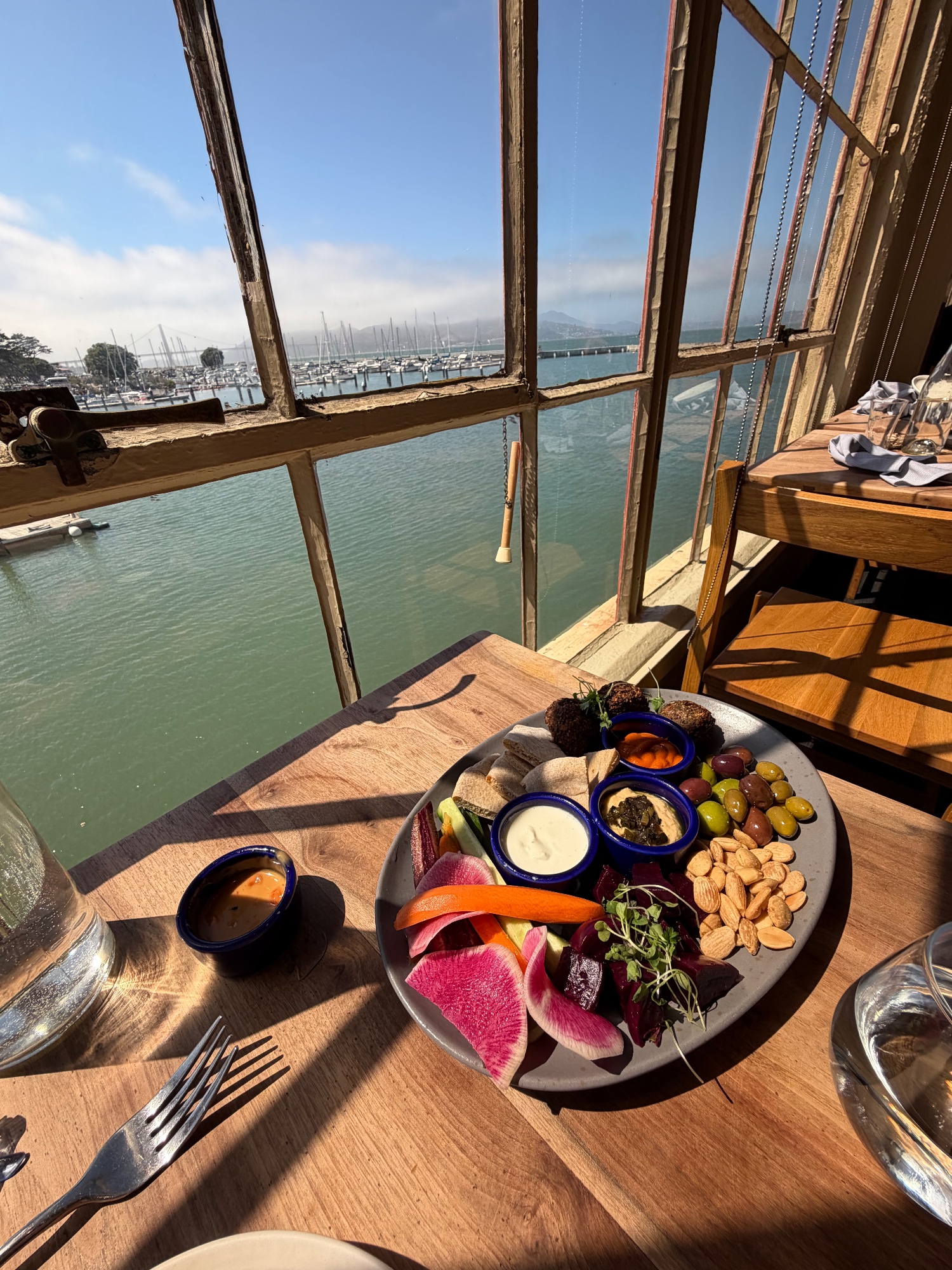
We had barely sat down before it became clear that Greens was going to have an unfair advantage.
Beyond the floor-to-ceiling windows, the bay spread out in an almost impossibly beautiful sweep of blue. The Golden Gate Bridge hung in the distance, the Marin hills rose behind it, and sailboats moved across the water slowly enough to make you forget, for a moment, that you were sitting inside a restaurant at all.
Then the food began to arrive.
Suddenly there was color everywhere.
A plate of greens and herbs appeared first, followed by vegetables in shades of yellow, crimson and deep green, then another dish, and another. What had been a spare wooden table became a small landscape of its own. There were vegetables roasted until their edges had darkened, others barely cooked at all, herbs scattered across plates as if they had just been picked, sauces bright enough to compete with the afternoon outside the windows.
It was beautiful food, but not fussy food. Nothing had been stacked into a tower or decorated into submission. The vegetables still looked like vegetables.
That may sound obvious. At Greens, it is almost the point.
Long before vegetable-forward cooking became a phrase restaurants used to describe themselves, Greens was building an entire cuisine around the idea that vegetables did not need to impersonate something else to justify their place at the center of the plate.
The restaurant opened in 1979 in a converted warehouse at Fort Mason, on the Marina waterfront, and has spent the decades since proving that vegetarian food doesn’t need to apologize for itself. The enormous windows facing the bay and Golden Gate Bridge have become as much a part of the Greens experience as anything emerging from its kitchen.
But Greens did not begin as a conventional restaurant venture.
It was founded by the San Francisco Zen Center, an organization whose three principal communities include City Center in San Francisco, Green Gulch Farm in Marin County and Tassajara Zen Mountain Center, tucked deep in the Ventana Wilderness.
At Tassajara, guests came for retreats and summer visits and ate meals prepared from the monastery’s kitchen and gardens. They liked the food enough that a question kept coming up: Where could they eat this way in San Francisco?
Greens became the answer.
There was another purpose as well. The restaurant offered Zen students a place to carry their practice into ordinary working life.
For years, its employees were Zen students.
That detail explains more about Greens than almost anything on its menu.
In Soto Zen, attention is not supposed to end when meditation does. Practice extends into work — including the repetitive, unglamorous work most people hurry through. Washing something. Cutting something. Sweeping a floor. Chopping a hundred vegetables.
At Greens, cooking dinner could be practice. So could carrying it across a dining room.
The idea sounds abstract until you eat there.
There is an unusual lack of anxiety in the food. Nothing seems desperate to impress you. A vegetable isn’t buried under enough butter, cheese or theatrical technique to make you forget what it was when it came out of the ground. Ingredients are allowed to taste emphatically like themselves.
That sensibility began with Greens’ founding chef, Deborah Madison.
Madison had been a Zen student and cooked at Tassajara before training at Chez Panisse. At Greens, she approached vegetarian cooking not as conventional cuisine with the meat extracted, but as a cuisine with its own vocabulary.
That distinction mattered enormously in 1979.
Vegetarian restaurants in America were still strongly associated with health-food culture: brown rice, sprouts, earnest casseroles and the underlying assumption that pleasure was not necessarily the point. Madison went in another direction, drawing heavily from Mediterranean cooking and building dishes around vegetables, grains, cheeses, herbs and the produce coming into the restaurant.
The goal was not to make diners think, “This is good for vegetarian food.”
It was to make them stop thinking about the category altogether.
Another crucial part of that story was growing seventeen miles north of San Francisco.
Green Gulch Farm, the Zen Center’s 115-acre community in Marin, has supplied Greens with vegetables and herbs since the restaurant’s earliest days. Its organic farm and gardens are not simply vendors attached to a restaurant; they belong to the same community and grew from the same philosophy.
So a line can be drawn from a seed planted at Green Gulch to a cook standing at a cutting board in Fort Mason to the plate eventually placed in front of a diner overlooking the bay.
Chard, squash, leeks, lettuces and herbs travel that line.
So does an idea: pay attention.
After Madison, Annie Somerville became the chef most closely identified with Greens, guiding the kitchen for decades and helping turn the restaurant into a San Francisco institution. A succession of women has continued to lead the kitchen, including current executive chef Katie Reicher.
That continuity is striking. Restaurants reinvent themselves compulsively. Greens has changed — of course it has — but its central argument has barely moved.
Vegetables are enough.
Eating there nearly half a century after it opened, the most surprising thing may be how contemporary that argument now sounds.
The rest of American dining has moved noticeably in Greens’ direction. Farmers markets became fashionable, then expected. Seasonal menus became a mark of seriousness. Farm-to-table went from an actual description of a supply chain to a marketing phrase printed on restaurant websites across the country. Chefs began putting vegetables at the center of plates without feeling obligated to explain themselves.
Greens was doing much of this before there was convenient language for it.
And yet the restaurant itself does not feel like a monument to its own influence.
That afternoon, history was not what commanded our attention.
Lunch did.
The plates kept arriving, each one brighter than the last. We tasted something, looked back toward the water, talked, reached across the table for another bite. Outside, the bridge remained framed in the enormous windows as though somebody had hung it there intentionally.
There is a temptation, in a room like this, to credit everything to the view.
Certainly the view does some work.
But then you look back down at the table.
There is something green and crisp on your fork, something grown not very far from where you’re sitting. Someone planted it. Someone harvested it. Someone washed it, cut it and decided exactly how much — or how little — needed to be done to it before it reached you.
That chain of attention is essentially the Greens story.
A monastery kitchen. A farm in Marin. A converted warehouse beside San Francisco Bay. Generations of cooks, many of them women, working from the radical proposition that a vegetable need not pretend to be anything other than what it is.
Forty-seven years after Greens opened, diners still sit down in front of that enormous expanse of water and sky.
Then the food arrives.
And somehow, you remember to look down.