
On a road trip down the Oregon coast, you might reasonably expect to encounter a lighthouse, a fishing harbor, perhaps a particularly good bowl of chowder. Two eight-foot pharaohs standing guard over a movie theater are less likely to be on your itinerary.
Yet there they are, inside the Egyptian Theatre in downtown Coos Bay. Outside, Broadway belongs to a working coastal town shaped by timber, shipping, and the weather. Inside, cobra-shaped door handles and Egyptian ornament suggest that your evening is headed somewhere considerably farther away.
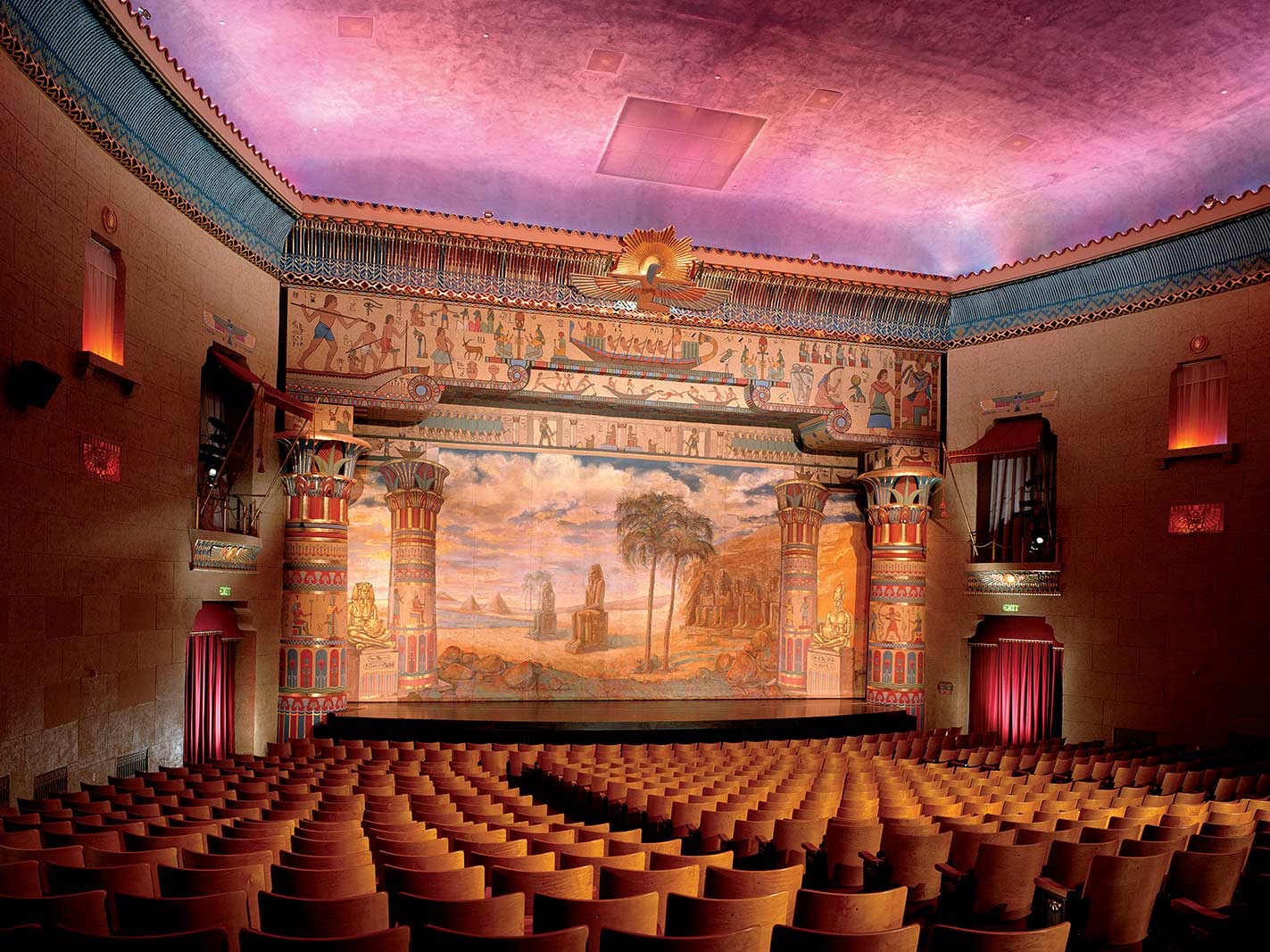
Give yourself time before the movie. There are hieroglyphs to inspect, statues to pose beside, and an auditorium conceived when going to the pictures was an occasion worth dressing for. If the original Wurlitzer is being played, you may find yourself settling into your seat well before the screen lights up.
The surprise is not simply that Coos Bay has an Egyptian movie palace. It is that, a century after opening, the town still has a use for one.

A Palace in a Lumber Town
The Egyptian’s beginnings were considerably less glamorous than its name suggests. Before there were pharaohs, there was a garage.
In 1925, John C. Noble and Robert Marsden Jr. of the Coos Bay Amusement Company commissioned Portland architect Lee Arden Thomas and designer Carl F. Berg to transform the Motor Inn Garage and Service Station into a theater. The resulting house held 1,274 seats and a Wurlitzer organ that cost $32,000—a substantial investment in the sound of an evening out.
The town was then called Marshfield. Its prosperity came from the harbor and the timber moving through it. Sawmills employed local families, ships carried lumber away, and the railroad connection that arrived in 1916 widened the town’s reach.
A lavish theater belonged to that ambition. Movie palaces offered growing American towns a way to announce that they had arrived. Here, people whose working days revolved around logs, machinery, and tides could spend an evening surrounded by the imagined splendor of ancient Egypt.
On November 19, 1925, the Egyptian opened with dinner on the stage for local residents and representatives from Hollywood studios. Vaudeville entertainment and motion pictures followed. The garage had become somewhere to go.
Egypt Comes to the Oregon Coast
The choice of décor was timely. Howard Carter’s discovery of Tutankhamun’s tomb in 1922 had sent images of ancient Egyptian treasures around the world. Architects and theater owners recognized an irresistible setting for the new business of transporting audiences through moving pictures.
Egyptian Revival architecture already had a history, but the discovery gave it fresh momentum. Pharaohs, lotus motifs, sun disks, and hieroglyphic decoration offered a ready-made atmosphere of distant places and buried mysteries.
For a movie theater, the appeal was obvious. The journey could begin before the film.
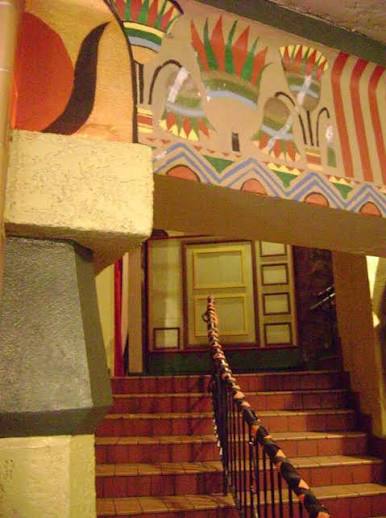
At the Egyptian, that idea survives in the details. The statues, known locally as Foster and Stanley, give the lobby its imposing—and unusually photogenic—hosts. The cobra handles make even opening a door part of the production. Inside the auditorium, Egyptian motifs and warm colors carry the theme beyond the entrance.
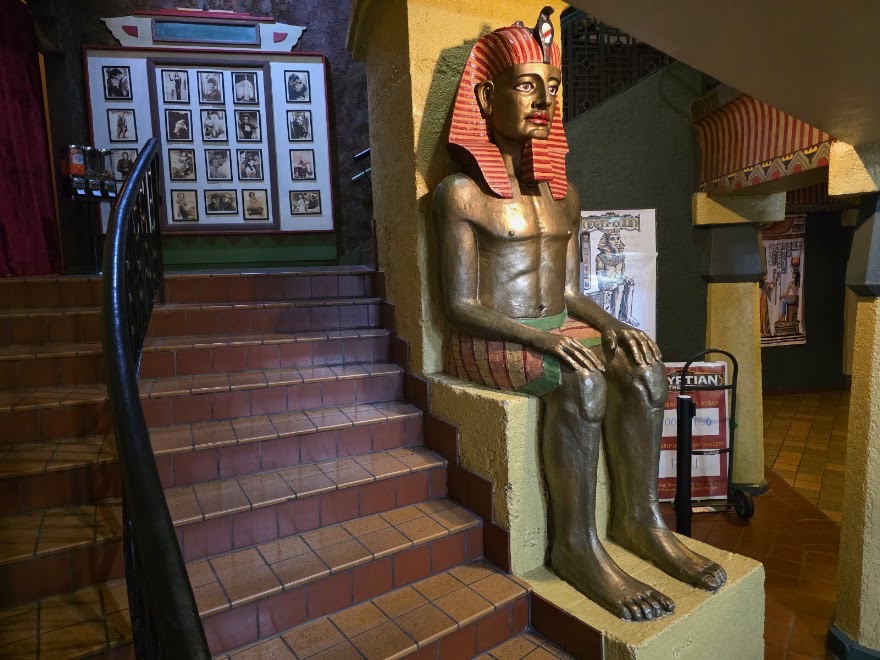
It is worth slowing down to look. An ordinary trip to the movies encourages you to pass quickly through the lobby, collect your concessions, and find a seat. This building rewards a little lingering.
The ornament also tells you something about the confidence of its creators. They were not content to provide a screen and enough chairs. They wanted the room itself to be remembered.
Hear It Before You See It
The Wurlitzer is among the theater’s most compelling reasons to visit.
Installed for the Egyptian’s opening era, the pipe organ recalls a time when movies arrived without a recorded soundtrack. Music helped establish the mood, accompany the action, and give a silent performance its emotional scale. The organist was part of the show.
Today, the instrument remains a working link to that experience. The theater advertises live Wurlitzer performances before its Wednesday with Walt screenings, giving visitors a chance to hear the building as well as admire it.
Check the calendar before planning around a performance. If the organ is on the program, arrive early enough to enjoy it without spending the opening minutes searching for your seat.
A historic theater can be fascinating when empty. Hearing its original instrument with an audience in the room offers something more immediate: an understanding of why people once built such elaborate places for entertainment.
The Years the Lights Went Out
The Egyptian’s survival was never assured.
Changing ownership and deferred maintenance took their toll. Roof leaks and water damage threatened a building whose elaborate interior made repairs especially consequential. When the theater went up for sale in 2005, local supporters persuaded the city’s Urban Renewal Agency to intervene.
The Egyptian Theatre Preservation Association took on the work of keeping it operating and raising money for its future. National Register recognition followed in 2010, but recognition alone could not make the building safe.
A structural survey revealed serious problems, including an unstable roof and a sinking stage. The theater closed in 2011.
That interruption is important to its story. The Egyptian did not simply coast into old age, protected by its charm. People had to decide that it was worth repairing, find the resources, and bring audiences back. It reopened in 2014 with support from the city, the preservation association, and the community.
The volunteers working concessions, taking tickets, and helping visitors are part of that continuing effort. Their presence makes the Egyptian feel less like a preserved curiosity than a place the town has chosen to keep using.
Make an Evening of It
Coos Bay is an appealing setting for this sort of discovery. Its downtown belongs to a harbor town with a working history, and the theater gives a walk through those streets an unexpected destination.
Allow time for dinner before the show and a look around downtown. Bring a jacket for the coastal air. Then approach the Egyptian at a leisurely pace, looking up at the sign before stepping into the lobby.
The programming includes movies, concerts, and community events, so the experience depends on the evening you choose. A classic film suits the surroundings, but there is also pleasure in seeing an old palace filled for an entirely contemporary occasion. A building stays alive by accommodating new reasons to gather.
For travelers, the Egyptian offers an unusually intimate encounter with the coast’s history. You do not need to book a tour or imagine the auditorium in its prime. You can buy a ticket, take a seat, and spend an evening there.
Outside, Coos Bay will still be Coos Bay when the show ends. Inside, for a few hours, a lumber town’s extravagant idea of Egypt has held the room.
The pharaohs will see you out.
Planning your visit: The Egyptian Theatre is at 229 South Broadway, Coos Bay, Oregon. Check the current program and organ performances before traveling. The box office generally opens 30 minutes before showtime; call or text 541-808-8295 for details.
Sources: The Oregon Encyclopedia; Egyptian Theatre.